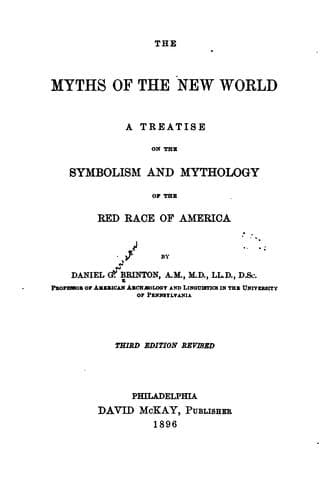
The Myths of the New World: A Treatise on the Symbolism and Mythology of the Red Race of AmericaBrinton, Daniel G. (Daniel Garrison)
Religion
The Myths of the New World: A Treatise on the Symbolism and Mythology of the Red Race of America
Brinton, Daniel G. (Daniel Garrison)
Indian mythology; Indians -- Folklore
There was an ancient Christian heresy which taught that the true way to
conquer the passions was to satiate them, and therefore preached
unbounded licentiousness. Whether this agreeable doctrine was known to
the Indians I cannot say, but it is certainly the most creditable
explanation that can be suggested for the miscellaneous congress which
very often terminated their dances and ceremonies. Such orgies were of
common occurrence among the Algonkins and Iroquois at a very early date,
and are often mentioned in the Jesuit Relations; Venegas describes them
as frequent among the tribes of Lower California; and Oviedo refers to
certain festivals of the Nicaraguans, during which the women of all rank
extended to whosoever wished just such privileges as the matrons of
ancient Babylon, that mother of harlots and all abominations, used to
grant even to slaves and strangers in the temple of Melitta, as one of
the duties of religion. But in fact there is no ground whatever to
invest these debauches with any recondite meaning. They are simply
indications of the thorough and utter immorality which prevailed
throughout the race. And a still more disgusting proof of it is seen in
the frequent appearance among diverse tribes of men dressed as women and
yielding themselves to indescribable vices.[149-1] There was at first
nothing of a religious nature in such exhibitions. Lascivious priests
chose at times to invest them with some such meaning for their own
sensual gratification, just as in Brazil they still claim the _jus primæ
noctis_.[149-2] The pretended phallic worship of the Natchez and of
Culhuacan, cited by the Abbé Brasseur, rests on no good authority, and
if true, is like that of the Huastecas of Panuco, nothing but an
unrestrained and boundless profligacy which it were an absurdity to call
a religion.[149-3] That which Mr. Stephens attempts to show existed once
in Yucatan,[149-4] rests entirely by his own statement on a fancied
resemblance of no value whatever, and the arguments of Lafitau to the
same effect are quite insufficient. There is a decided indecency in the
remains of ancient American art, especially in Peru (Meyen), and great
lubricity in many ceremonies, but the proof is altogether wanting to
bind these with the recognition of a fecundating principle throughout
nature, or, indeed, to suppose for them any other origin than the
promptings of an impure fancy. I even doubt whether they often referred
to fire as the deity of sexual love.
Public-domain text, read in full here on John Shaqi.
Reviews
Reviews
No reviews yet
Be the first to share your thoughts on this work.
Elsewhere in the archive
Join the Discussion
Join the discussion
Sign in to leave a comment or review.
Sign InorCreate an account