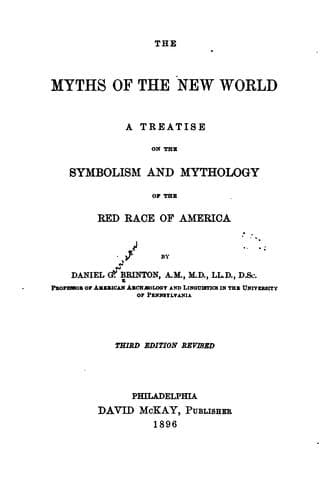
The Myths of the New World: A Treatise on the Symbolism and Mythology of the Red Race of AmericaBrinton, Daniel G. (Daniel Garrison)
Religion
The Myths of the New World: A Treatise on the Symbolism and Mythology of the Red Race of America
Brinton, Daniel G. (Daniel Garrison)
Indian mythology; Indians -- Folklore
By a flight of fancy inspired by a study of oriental mythology, the
worship of the reciprocal principle in America has been connected with
that of the sun and moon, as the primitive pair from whose fecund union
all creatures proceeded. It is sufficient to say if such a myth exists
among the Indians--which is questionable--it justifies no such
deduction; that the moon is often mentioned in their languages merely as
the "night sun;" and that in such important stocks as the Iroquois,
Athapascas, Cherokees, and Tupis, the sun is said to be a feminine noun;
while the myths represent them more frequently as brother and sister
than as man and wife; nor did at least the northern tribes regard the
sun as the cause of fecundity in nature at all, but solely as giving
light and warmth.[150-1]
In contrast to this, so much the more positive was their association of
the THUNDER-STORM as that which brings both warmth and rain with the
renewed vernal life of vegetation. The impressive phenomena which
characterize it, the prodigious noise, the awful flash, the portentous
gloom, the blast, the rain, have left a profound impression on the myths
of every land. Fire from water, warmth and moisture from the destructive
breath of the tempest, this was the riddle of riddles to the untutored
mind. "Out of the eater came forth meat, out of the strong came forth
sweetness." It was the visible synthesis of all the divine
manifestations, the winds, the waters, and the flames.
The Dakotas conceived it as a struggle between the god of waters and the
thunder bird for the command of their nation,[150-2] and as a bird, one
of those which make a whirring sound with their wings, the turkey, the
pheasant, or the nighthawk, it was very generally depicted by their
neighbors, the Athapascas, Iroquois, and Algonkins.[151-1] As the
herald of the summer it was to them a good omen and a friendly power. It
was the voice of the Great Spirit of the four winds speaking from the
clouds and admonishing them that the time of corn planting was at
hand.[151-2] The flames kindled by the lightning were of a sacred
nature, proper to be employed in lighting the fires of the religious
rites, but on no account to be profaned by the base uses of daily life.
When the flash entered the ground it scattered in all directions those
stones, such as the flint, which betray their supernal origin by a gleam
of fire when struck. These were the thunderbolts, and from such an one,
significantly painted red, the Dakotas averred their race had
proceeded.[151-3] For are we not all in a sense indebted for our lives
to fire? "There is no end to the fancies entertained by the Sioux
concerning thunder," observes Mrs. Eastman. They typified the
paradoxical nature of the storm under the character of the giant Haokah.
To him cold was heat, and heat cold; when sad he laughed, when merry
groaned; the sides of his face and his eyes were of different colors and
expressions; he wore horns or a forked headdress to represent the
Public-domain text, read in full here on John Shaqi.
Reviews
Reviews
No reviews yet
Be the first to share your thoughts on this work.
Elsewhere in the archive
Join the Discussion
Join the discussion
Sign in to leave a comment or review.
Sign InorCreate an account