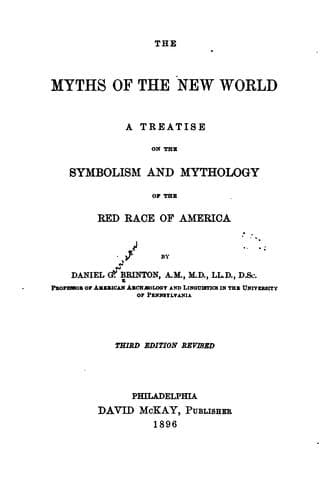
The Myths of the New World: A Treatise on the Symbolism and Mythology of the Red Race of AmericaBrinton, Daniel G. (Daniel Garrison)
Religion
The Myths of the New World: A Treatise on the Symbolism and Mythology of the Red Race of America
Brinton, Daniel G. (Daniel Garrison)
Indian mythology; Indians -- Folklore
So strong is the resemblance Ioskeha bears to Michabo, that what has
been said in explanation of the latter will be sufficient for both. Yet
I do not imagine that the one was copied or borrowed from the other. We
cannot be too cautious in adopting such a conclusion. The two nations
were remote in everything but geographical position. I call to mind
another similar myth. In it a mother is also said to have brought forth
twins, or a pair of twins, and to have paid for them with her life.
Again the one is described as the bright, the other as the dark twin;
again it is said that they struggled one with the other for the mastery.
Scholars, likewise, have interpreted the mother to mean the Dawn, the
twins either Light and Darkness, or the Four Winds. Yet this is not
Algonkin theology; nor is it at all related to that of the Iroquois. It
is the story of Sarama in the Rig Veda, and was written in Sanscrit,
under the shadow of the Himalayas, centuries before Homer.
Such uniformity points not to a common source in history, but in
psychology. Man, chiefly cognizant of his soul through his senses,
thought with an awful horror of the night which deprived him of the use
of one and foreshadowed the loss of all. Therefore _light_ and _life_
were to him synonymous; therefore all religions promise to lead
"From night to light,
From night to heavenly light;"
therefore He who rescues is ever the Light of the World; therefore it is
said "to the upright ariseth light in darkness;" therefore everywhere
the kindling East, the pale Dawn, is the embodiment of his hopes and the
centre of his reminiscences. Who shall say that his instinct led him
here astray? For is not, in fact, all life dependent on light? Do not
all those marvellous and subtle forces known to the older chemists as
the imponderable elements, without which not even the inorganic crystal
is possible, proceed from the rays of light? Let us beware of that
shallow science so ready to shout Eureka, and reverently acknowledge a
mysterious intuition here displayed which joins with the latest
conquests of the human mind to repeat and emphasize that message which
the Evangelist heard of the Spirit and declared unto men, that "God is
Light."[173-1]
Public-domain text, read in full here on John Shaqi.
Reviews
Reviews
No reviews yet
Be the first to share your thoughts on this work.
Elsewhere in the archive
Join the Discussion
Join the discussion
Sign in to leave a comment or review.
Sign InorCreate an account