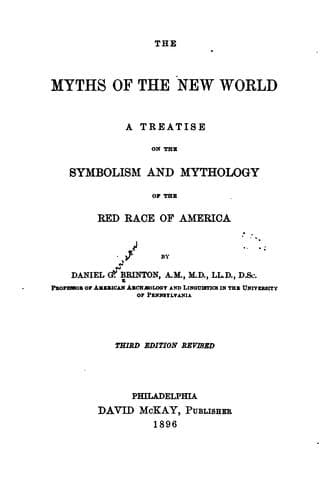
The Myths of the New World: A Treatise on the Symbolism and Mythology of the Red Race of AmericaBrinton, Daniel G. (Daniel Garrison)
Religion
The Myths of the New World: A Treatise on the Symbolism and Mythology of the Red Race of America
Brinton, Daniel G. (Daniel Garrison)
Indian mythology; Indians -- Folklore
Both these heroes, let it be observed, live in the uttermost east; both
are the mythical fathers of the race. To the east, therefore, should
these nations have pointed as their original dwelling place. This they
did in spite of history. Cusic, who takes up the story of the Iroquois a
thousand years before the Christian era, locates them first in the most
eastern region they ever possessed. While the Algonkins with one voice
called those of their tribes living nearest the rising sun _Abnakis_,
our ancestors at the east, or at the dawn; literally our _white_
ancestors.[174-1] I designedly emphasize this literal rendering. It
reminds one of the white twin of Iroquois legend, and illustrates how
the color white came to be intimately associated with the morning light
and its beneficent effects. Moreover color has a specific effect on the
mind; there is a music to the eye as well as to the ear; and white,
which holds all hues in itself, disposes the soul to all pleasant and
elevating emotions.[174-2] Not fashion alone bids the bride wreathe her
brow with orange flowers, nor was it a mere figure of speech that led
the inspired poet to call his love "fairest among women," and to
prophecy a Messiah "fairer than the children of men," fulfilled in that
day when He appeared "in garments so white as no fuller on earth could
white them." No nation is free from the power of this law. "White,"
observes Adair of the southern Indians, "is their fixed emblem of peace,
friendship, happiness, prosperity, purity, and holiness."[175-1] Their
priests dressed in white robes, as did those of Peru and Mexico; the
kings of the various species of animals were all supposed to be
white;[175-2] the cities of refuge established as asylums for alleged
criminals by the Cherokees in the manner of the Israelites were called
"white towns," and for sacrifices animals of this color were ever most
highly esteemed. All these sentiments were linked to the dawn. Language
itself is proof of it. Many Algonkin words for east, morning, dawn, day,
light, as we have already seen, are derived from a radical signifying
_white_. Or we can take a tongue nowise related, the Quiché, and find
its words for east, dawn, morning, light, bright, glorious, happy,
noble, all derived from _zak_, white. We read in their legends of the
earliest men that they were "white children," "white sons," leading "a
white life beyond the dawn," and the creation itself is attributed to
the Dawn, the White One, the White Sacrificer of Blood.[175-3] But why
insist upon the point when in European tongues we find the daybreak
called _l'aube_, _alva_, from _albus_, white? Enough for the purpose if
the error of those is manifest, who, in such expressions, would seek
support for any theory of ancient European immigration; enough if it
displays the true meaning of those traditions of the advent of
benevolent visitors of fair complexion in ante-Columbian times, which
Public-domain text, read in full here on John Shaqi.
Reviews
Reviews
No reviews yet
Be the first to share your thoughts on this work.
Elsewhere in the archive
Join the Discussion
Join the discussion
Sign in to leave a comment or review.
Sign InorCreate an account