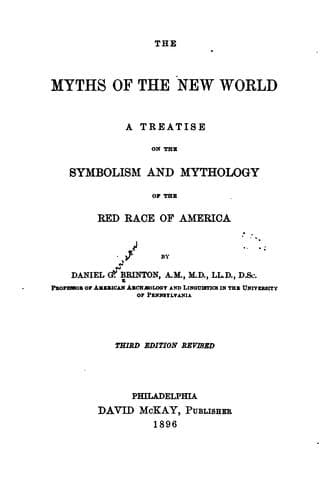
The Myths of the New World: A Treatise on the Symbolism and Mythology of the Red Race of AmericaBrinton, Daniel G. (Daniel Garrison)
Religion
The Myths of the New World: A Treatise on the Symbolism and Mythology of the Red Race of America
Brinton, Daniel G. (Daniel Garrison)
Indian mythology; Indians -- Folklore
both Algonkins and Iroquois[176-1] had in common with many other tribes
of the western continent. Their explanation will not be found in the
annals of Japan, the triads of the Cymric bards, nor the sagas of
Icelandic skalds, but in the propensity of the human mind to attribute
its own origin and culture to that white-shining orient where sun, moon,
and stars, are daily born in renovated glory, to that fair mother, who,
at the cost of her own life, gives light and joy to the world, to the
brilliant womb of Aurora, the glowing bosom of the Dawn.
Even the complicated mythology of Peru yields to the judicious
application of these principles of interpretation. Its peculiar
obscurity arises from the policy of the Incas to blend the religions of
conquered provinces with their own. Thus about 1350 the Inca Pachacutec
subdued the country about Lima where the worship of Con and Pachacamà
prevailed.[176-2] The local myth represented these as father and son,
or brothers, children of the sun. They were without flesh or blood,
impalpable, invisible, and incredibly swift of foot. Con first possessed
the land, but Pachacamà attacked and drove him to the north. Irritated
at his defeat he took with him the rain, and consequently to this day
the sea-coast of Peru is largely an arid desert. Now when we are
informed that the south wind, that in other words which blows to the
north, is the actual cause of the aridity of the low-lands,[177-1] and
consider the light and airy character of these antagonists, we cannot
hesitate to accept this as a myth of the winds. The name of _Con tici_,
the Thunder Vase, was indeed applied to Viracocha in later times, but
they were never identical. Viracocha was the culture hero of the ancient
Aymara-Quichua stock. He was more than that, for in their creed he was
creator and possessor of all things. Lands and herds were assigned to
other gods to support their temples, and offerings were heaped on their
altars, but to him none. For, asked the Incas: "Shall the Lord and
Master of the whole world need these things from us?" To him, says
Acosta, "they did attribute the chief power and commandement over all
things;" and elsewhere "in all this realm the chief idoll they did
worship was Viracocha, and _after him_ the Sunne."[178-1]
Public-domain text, read in full here on John Shaqi.
Reviews
Reviews
No reviews yet
Be the first to share your thoughts on this work.
Elsewhere in the archive
Join the Discussion
Join the discussion
Sign in to leave a comment or review.
Sign InorCreate an account