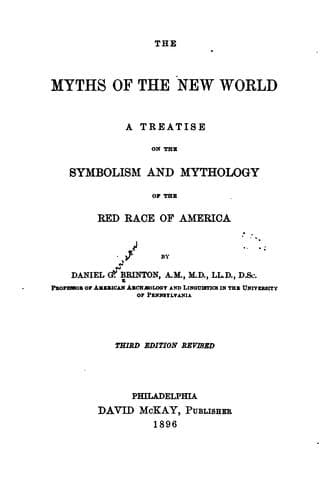
The Myths of the New World: A Treatise on the Symbolism and Mythology of the Red Race of AmericaBrinton, Daniel G. (Daniel Garrison)
Religion
The Myths of the New World: A Treatise on the Symbolism and Mythology of the Red Race of America
Brinton, Daniel G. (Daniel Garrison)
Indian mythology; Indians -- Folklore
Ere sun or moon was made, he rose from the bosom of Lake Titicaca, and
presided over the erection of those wondrous cities whose ruins still
dot its islands and western shores, and whose history is totally lost in
the night of time. He himself constructed these luminaries and placed
them in the sky, and then peopled the earth with its present
inhabitants. From the lake he journeyed westward, not without
adventures, for he was attacked with murderous intent by the beings whom
he had created. When, however, scorning such unequal combat, he had
manifested his power by hurling the lightning on the hill-sides and
consuming the forests, they recognized their maker, and humbled
themselves before him. He was reconciled, and taught them arts and
agriculture, institutions and religion, meriting the title they gave him
of _Pachayachachic_, teacher of all things. At last he disappeared in
the western ocean. Four personages, companions or sons, were closely
connected with him. They rose together with him from the lake, or else
were his first creations. These are the four mythical civilizers of
Peru, who another legend asserts emerged from the cave Pacarin tampu the
Lodgings of the Dawn.[179-1] To these Viracocha gave the earth, to one
the north, to another the south, to a third the east, to a fourth the
west. Their names are very variously given, but as they have already
been identified with the four winds, we can omit their consideration
here.[179-2] Tradition, as has rightly been observed by the Inca
Garcilasso de la Vega,[179-3] transferred a portion of the story of
Viracocha to Manco Capac, first of the historical Incas. King Manco,
however, was a real character, the Rudolph of Hapsburg of their reigning
family, and flourished about the eleventh century.
There is a general resemblance between this story and that of Michabo.
Both precede and create the sun, both journey to the west, overcoming
opposition with the thunderbolt, both divide the world between the four
winds, both were the fathers, gods, and teachers of their nations. Nor
does it cease here. Michabo, I have shown, is the white spirit of the
Dawn. Viracocha, all authorities translate "the fat or foam of the sea."
The idea conveyed is of whiteness, foam being called fat from its
color.[180-1] So true is this that to-day in Peru white men are called
_viracochas_, and the early explorers constantly received the same
epithet.[180-2] The name is a metaphor. The dawn rises above the horizon
as the snowy foam on the surface of a lake. As the Algonkins spoke of
the Abnakis, their white ancestors, as in Mexican legends the early
Toltecs were of fair complexion, so the Aymaras sometimes called the
first four brothers, _viracochas_, white men.[180-3] It is the ancient
story how
"Light
Sprang from the deep, and from her native east
To journey through the airy gloom began."
Public-domain text, read in full here on John Shaqi.
Reviews
Reviews
No reviews yet
Be the first to share your thoughts on this work.
Elsewhere in the archive
Join the Discussion
Join the discussion
Sign in to leave a comment or review.
Sign InorCreate an account