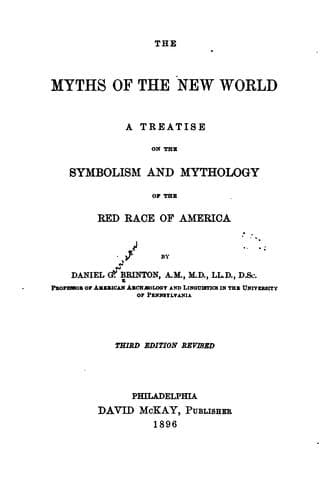
The Myths of the New World: A Treatise on the Symbolism and Mythology of the Red Race of AmericaBrinton, Daniel G. (Daniel Garrison)
Religion
The Myths of the New World: A Treatise on the Symbolism and Mythology of the Red Race of America
Brinton, Daniel G. (Daniel Garrison)
Indian mythology; Indians -- Folklore
The central figure of Toltec mythology is Quetzalcoatl. Not an author on
ancient Mexico but has something to say about the glorious days when he
ruled over the land. No one denies him to have been a god, the god of
the air, highest deity of the Toltecs, in whose honor was erected the
pyramid of Cholula, grandest monument of their race. But many insist
that he was at first a man, some deified king. There were in truth many
Quetzalcoatls, for his high priest always bore his name, but he himself
is a pure creation of the fancy, and all his alleged history is nothing
but a myth.
His emblematic name, the Bird-Serpent, and his rebus and cross at
Palenque, I have already explained. Others of his titles were, Ehecatl,
the air; Yolcuat, the rattlesnake; Tohil, the rumbler; Huemac, the
strong hand; Nani he hecatle, lord of the four winds. The same dualism
reappears in him that has been noted in his analogues elsewhere; He is
both lord of the eastern light and the winds.
As the former, he was born of a virgin in the land of Tula or Tlapallan,
in the distant Orient, and was high priest of that happy realm. The
morning star was his symbol, and the temple of Cholula was dedicated to
him expressly as the author of light.[181-1] As by days we measure time,
he was the alleged inventor of the calendar. Like all the dawn heroes,
he too was represented as of white complexion, clothed in long white
robes, and, as most of the Aztec gods, with a full and flowing
beard.[181-2] When his earthly-work was done he too returned to the
east, assigning as a reason that the sun, the ruler of Tlapallan,
demanded his presence. But the real motive was that he had been
overcome by Tezcatlipoca, otherwise called Yoalliehecatl, the wind or
spirit of night, who had descended from heaven by a spider's web and
presented his rival with a draught pretended to confer immortality, but,
in fact, producing uncontrollable longing for home. For the wind and the
light both depart when the gloaming draws near, or when the clouds
spread their dark and shadowy webs along the mountains, and pour the
vivifying rain upon the fields.
Public-domain text, read in full here on John Shaqi.
Reviews
Reviews
No reviews yet
Be the first to share your thoughts on this work.
Elsewhere in the archive
Join the Discussion
Join the discussion
Sign in to leave a comment or review.
Sign InorCreate an account