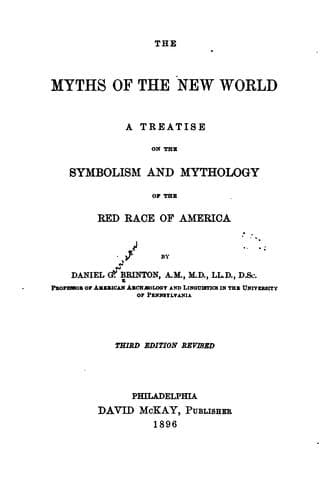
The Myths of the New World: A Treatise on the Symbolism and Mythology of the Red Race of AmericaBrinton, Daniel G. (Daniel Garrison)
Religion
The Myths of the New World: A Treatise on the Symbolism and Mythology of the Red Race of America
Brinton, Daniel G. (Daniel Garrison)
Indian mythology; Indians -- Folklore
In his other character, he was begot of the breath of Tonacateotl, god
of our flesh or subsistence,[182-1] or (according to Gomara) was the son
of Iztac Mixcoatl, the white cloud serpent, the spirit of the tornado.
Messenger of Tlaloc, god of rains, he was figuratively said to sweep the
road for him, since in that country violent winds are the precursors of
the wet seasons. Wherever he went all manner of singing birds bore him
company, emblems of the whistling breezes. When he finally disappeared
in the far east, he sent back four trusty youths who had ever shared his
fortunes, "incomparably swift and light of foot," with directions to
divide the earth between them and rule it till he should return and
resume his power. When he would promulgate his decrees, his herald
proclaimed them from Tzatzitepec, the hill of shouting, with such a
mighty voice that it could be heard a hundred leagues around. The arrows
which he shot transfixed great trees, the stones he threw levelled
forests, and when he laid his hands on the rocks the mark was indelible.
Yet as thus emblematic of the thunder-storm, he possessed in full
measure its better attributes. By shaking his sandals he gave fire to
men, and peace, plenty, and riches blessed his subjects. Tradition says
he built many temples to Mictlanteuctli, the Aztec Pluto, and at the
creation of the sun that he slew all the other gods, for the advancing
dawn disperses the spectral shapes of night, and yet all its vivifying
power does but result in increasing the number doomed to fell before the
remorseless stroke of death.[183-1]
His symbols were the bird, the serpent, the cross, and the flint,
representing the clouds, the lightning, the four winds, and the
thunderbolt. Perhaps, as Huemac, the Strong Hand, he was god of the
earthquakes. The Zapotecs worshipped such a deity under the image of
this member carved from a precious stone,[183-2] calling to mind the
"Kab ul," the Working Hand, adored by the Mayas,[183-3] and said to be
one of the images of Zamna, their hero god. The human hand, "that divine
tool," as it has been called, might well be regarded by the reflective
mind as the teacher of the arts and the amulet whose magic power has won
for man what vantage he has gained in his long combat with nature and
his fellows.
Public-domain text, read in full here on John Shaqi.
Reviews
Reviews
No reviews yet
Be the first to share your thoughts on this work.
Elsewhere in the archive
Join the Discussion
Join the discussion
Sign in to leave a comment or review.
Sign InorCreate an account