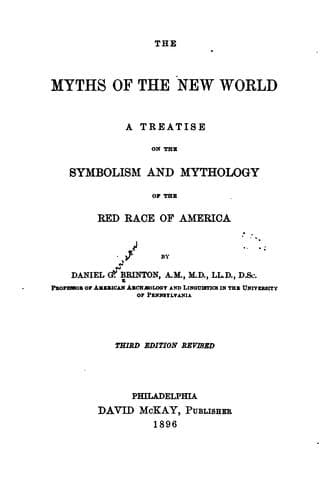
The Myths of the New World: A Treatise on the Symbolism and Mythology of the Red Race of AmericaBrinton, Daniel G. (Daniel Garrison)
Religion
The Myths of the New World: A Treatise on the Symbolism and Mythology of the Red Race of America
Brinton, Daniel G. (Daniel Garrison)
Indian mythology; Indians -- Folklore
[171-1] This offers an instance of the uniformity which prevailed in
symbolism in the New World. The Aztecs adored the goddess of water under
the figure of a frog carved from a single emerald; or of human form, but
holding in her hand the leaf of a water lily ornamented with frogs.
(Brasseur, _Hist. du Mexique_, i. p. 324.)
[171-2] _Rel. de la Nouv. France_, 1636, p. 101.
[172-1] _Rel. de la Nouv. France_, 1671, p. 17. Cusic spells it
_Tarenyawagon_, and translates it Holder of the Heavens. But the name is
evidently a compound of _garonhia_, sky, softened in the Onondaga dialect
to _taronhia_ (see Gallatin's Vocabs. under the word sky), and _wagin_, I
come.
[173-1] Ὁ Θεος φως εστι, The First Epistle General of John, i. 5. In
curious analogy to these myths is that of the Eskimos of Greenland. In
the beginning, they relate, were two brothers, one of whom said: "There
shall be night and there shall be day, and men shall die, one after
another." But the second said, "There shall be no day, but only night
all the time, and men shall live forever." They had a long struggle, but
here once more he who loved darkness rather than light was worsted, and
the day triumphed. (_Nachrichten von Grönland aus einem Tagebuche vom
Bischof Paul Egede_, p. 157: Kopenhagen, 1790. The date of the entry is
1738.)
[174-1] I accept without hesitation the derivation of this word, proposed
and defended by that accomplished Algonkin scholar, the Rev. Eugene
Vetromile, from _wanb_, white or east, and _naghi_ ancestors (_The
Abnakis and their History_, p. 29: New York, 1866).
[174-2] White light, remarks Goethe, has in it something cheerful and
ennobling; it possesses "eine heitere, muntere, sanft reizende
Eigenschaft." _Farbenlehre_, sec's 766, 770.
[175-1] _Hist. of the N. Am. Indians_, p. 159.
[175-2] La Hontan, _Voy. dans l'Amér. Sept._, ii. p. 42.
[175-3] "Blanco pizote," Ximenes, p. 4, _Vocabulario Quiché_, s. v.
_zak_. In the far north the Eskimo tongue presents the same analogy. Day,
morning, bright, light, lightning, all are from the same root (_kau_),
signifying white (Richardson, Vocab. of Labrador Eskimo).
[176-1] Some fragments of them may be found in Campanius, _Acc. of New
Sweden_, 1650, book iii. chap. 11, and in Byrd, _The Westover
Manuscripts_, 1733, p. 82. They were in both instances alleged to have
been white and bearded men, the latter probably a later trait in the
legend.
Public-domain text, read in full here on John Shaqi.
Reviews
Reviews
No reviews yet
Be the first to share your thoughts on this work.
Elsewhere in the archive
Join the Discussion
Join the discussion
Sign in to leave a comment or review.
Sign InorCreate an account