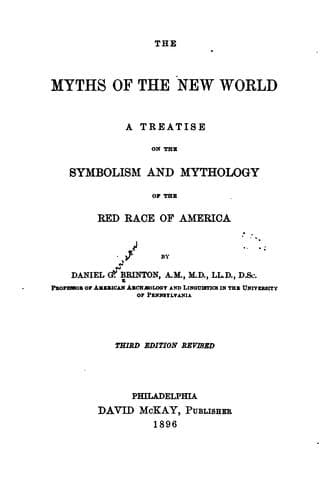
The Myths of the New World: A Treatise on the Symbolism and Mythology of the Red Race of AmericaBrinton, Daniel G. (Daniel Garrison)
Religion
The Myths of the New World: A Treatise on the Symbolism and Mythology of the Red Race of America
Brinton, Daniel G. (Daniel Garrison)
Indian mythology; Indians -- Folklore
[176-2] _Con_ or _Cun_ I have already explained to mean thunder, _Con
tici_, the mythical thunder vase. Pachacamà is doubtless, as M. Leonce
Angrand has suggested, from _ppacha_, source, and _camà_, all, the Source
of All things (Desjardins, _Le Pérou avant la Conq. Espagnole_, p. 23,
note). But he and all other writers have been in error in considering
this identical with _Pachacámac_, nor can the latter mean _creator of the
world_, as it has constantly been translated. It is a participial
adjective from _pacha_, place, especially the world, and _camac_, present
participle of _camani_, I animate, from which also comes _camakenc_, the
soul, and means _animating the world_. It was never used as a proper
name. The following trochaic lines from the Quichua poem translated in
the previous chapter, show its true meaning and correct accent:--
Pāchă rūrăc, World creating,
Pāchă cāmăc, World animating,
Viracocha, Viracocha,
Camasunqui, He animates thee.
The last word is the second transition, present tense, of _camani_, while
_camac_ is its present participle.
[177-1] Ulloa, _Mémoires Philosophiques sur l'Amérique_, i. p. 105.
[178-1] Acosta, _Hist. of the New World_, bk. v. chap. 4, bk. vi. chap.
19, Eng. trans., 1704.
[179-1] The name is derived from _tampu_, corrupted by the Spaniards to
_tambo_, an inn, and _paccari_ morning, or _paccarin_, it dawns, which
also has the figurative signification, it is born. It may therefore mean
either Lodgings of the Dawn, or as the Spaniards usually translated it,
House of Birth, or Production, _Casa de Producimiento_.
[179-2] The names given by Balboa (_Hist. du Pérou_, p. 4) and Montesinos
(_Ancien Pérou_, p. 5) are Manco, Cacha, Auca, Uchu. The meaning of Manco
is unknown. The others signify, in their order, messenger, enemy or
traitor, and the little one. The myth of Viracocha is given in its most
antique form by Juan de Betanzos, in the _Historia de los Ingas_,
compiled in the first years of the conquest from the original songs and
legends. It is quoted in Garcia, _Origen de los Indios_, lib. v. cap. 7.
Balboa, Montesinos, Acosta, and others have also furnished me some
incidents. Whether Atachuchu mentioned in the last chapter was not
another name of Viracocha may well be questioned. It is every way
probable.
[179-3] _Hist. des Incas_, liv. iii. chap. 25.
[180-1] It is compounded of _vira_, fat, foam (which perhaps is akin to
_yurac_, _white_), and _cocha_, a pond or lake.
[180-2] See Desjardins, _Le Pérou avant la Conq. Espagnole_, p. 67.
[180-3] Gomara, _Hist. de las Indias_, cap. 119, in Müller.
[181-1] Brasseur, _Hist. du Mexique_, i. p. 302.
Public-domain text, read in full here on John Shaqi.
Reviews
Reviews
No reviews yet
Be the first to share your thoughts on this work.
Elsewhere in the archive
Join the Discussion
Join the discussion
Sign in to leave a comment or review.
Sign InorCreate an account