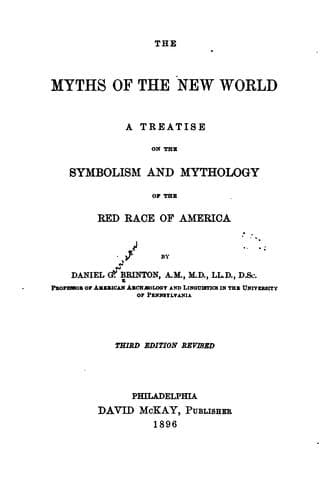
The Myths of the New World: A Treatise on the Symbolism and Mythology of the Red Race of AmericaBrinton, Daniel G. (Daniel Garrison)
Religion
The Myths of the New World: A Treatise on the Symbolism and Mythology of the Red Race of America
Brinton, Daniel G. (Daniel Garrison)
Indian mythology; Indians -- Folklore
[181-2] There is no reason to lay any stress upon this feature. Beard was
nothing uncommon among the Aztecs and many other nations of the New
World. It was held to add dignity to the appearance, and therefore
Sahagun, in his description of the Mexican idols, repeatedly alludes to
their beards, and Müller quotes various authorities to show that the
priests wore them long and full (_Amer. Urreligionen_, p. 429). Not only
was Quetzalcoatl himself reported to have been of fair complexion--white
indeed--but the Creole historian Ixtlilxochitl says the old legends
asserted that all the Toltecs, natives of Tollan, or Tula, as their name
signifies, were so likewise. Still more, Aztlan, the traditional home of
the Nahuas, or Aztecs proper, means literally the white land, according
to one of our best authorities (Buschmann, _Ueber die Aztekischen
Ortsnamen_, 612: Berlin, 1852).
[182-1] Kingsborough, _Antiquities of Mexico_, v. p. 109.
[183-1] The myth of Quetzalcoatl I have taken chiefly from Sahagun,
_Hist. de la Nueva España_, lib. i. cap. 5; lib. iii. caps. 3, 13, 14;
lib. x. cap. 29; and Torquemada, _Monarquia Indiana_, lib. vi. cap. 24.
It must be remembered that the Quiché legends identify him positively
with the Tohil of Central America (_Le Livre Sacré_, p. 247).
[183-2] Padilla Davila, _Hist. de la Prov. de Santiago de Mexico_, lib.
ii. cap. 89.
[183-3] Cogolludo, _Hist. de Yucathan_, lib. iv. cap. 8.
[184-1] He is also called Idacanzas and Nemterequetaba. Some have
maintained a distinction between Bochica and Sua, which, however, has not
been shown. The best authorities on the mythology of the Muyscas are
Piedrahita, _Hist. de las Conq. del Nuevo Reyno de Granada_, 1668 (who is
copied by Humboldt, _Vues des Cordillères_, pp. 246 sqq.), and Simon,
_Noticias de Tierra Firme_, Parte ii., in Kingsborough's _Mexico_.
[184-2] D'Orbigny, _L'Homme Américain_, ii. p. 319, and Rochefort,
_Hist. des Isles Antilles_, p. 482 (Waitz). The name has various
orthographies, Tamu, Tamöi, Tamou, Itamoulou, etc. Perhaps the Ama-livaca
of the Orinoko Indians is another form. This personage corresponds even
minutely in many points with the Tamu of the island Caribs.
[185-1] Catlin, _Letters and Notes_, Letter 22.
[185-2] Journal of Capt. Johnson, in Emory, _Reconnoissance of New
Mexico_, p. 601.
[185-3] M. De Charency, in the _Revue Américaine_, ii. p. 317. _Tupa_ it
may be observed means in Quichua, lord, or royal. Father Holguin gives as
an example _â tupa Dios_, O Lord God (_Vocabulario Quichua_, p. 348:
Ciudad de los Reyes, 1608). In the Quiché dialects _tepeu_ is one of the
common appellations of divinity and is also translated lord or ruler. We
are not yet sufficiently advanced in the study of American philology to
draw any inference from these resemblances, but they should not be
overlooked.
[187-1] Cortes, _Carta Primera_, pp. 113, 114.
[188-1] Sahagun, _Hist. de la Nueva España_, lib. xii. caps. 2, 3.
Public-domain text, read in full here on John Shaqi.
Reviews
Reviews
No reviews yet
Be the first to share your thoughts on this work.
Elsewhere in the archive
Join the Discussion
Join the discussion
Sign in to leave a comment or review.
Sign InorCreate an account