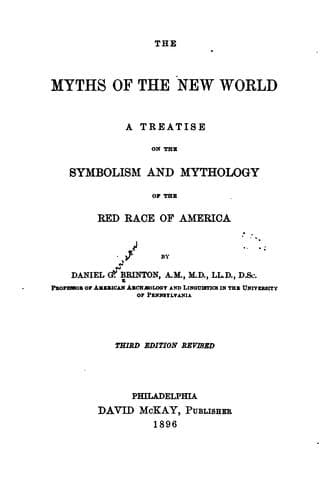
The Myths of the New World: A Treatise on the Symbolism and Mythology of the Red Race of AmericaBrinton, Daniel G. (Daniel Garrison)
Religion
The Myths of the New World: A Treatise on the Symbolism and Mythology of the Red Race of America
Brinton, Daniel G. (Daniel Garrison)
Indian mythology; Indians -- Folklore
[188-2] La Vega, _Hist. des Incas_, lib. ix. cap. 15.
[188-3] Peter Martyr, _De Reb. Oceanicis_, Dec. iii. lib. vii.
[189-1] Lizana, _Hist. de Nuestra Señora de Itzamal_, lib. ii. cap. i. in
Brasseur, _Hist. du Mexique_, ii. p. 605. The prophecies are of the
priest who bore the title--not name--_chilan balam_, and whose offices
were those of divination and astrology. The verse claims to date from
about 1450, and was very well known throughout Yucatan, so it is said.
The number thirteen which in many of these prophecies is the supposed
limit of the present order of things, is doubtless derived from the
observation that thirteen moons complete one solar year.
[190-1] Squier, _Travels in Nicaragua_, ii. p. 35.
[191-1] Whipple, _Report on the Ind. Tribes_, p. 36. Emory, _Recon. of
New Mexico_, p. 64. The latter adds that among the Pueblo Indians, the
Apaches, and Navajos, the name of Montezuma is "as familiar as Washington
to us." This is the more curious, as neither the Pueblo Indians nor
either of the other tribes are in any way related to the Aztec race by
language, as has been shown by Dr. Buschman, _Die Voelker und Sprachen
Neu Mexico's_, p. 262.
[191-2] Humboldt, _Essay on New Spain_, bk. ii. chap. vi, Eng. trans.;
_Ansichten der Natur_, ii. pp. 357, 386.
CHAPTER VII.
THE MYTHS OF THE CREATION, THE DELUGE, THE EPOCHS OF NATURE, AND THE
LAST DAY.
Cosmogonies usually portray the action of the SPIRIT on the
WATERS.--Those of the Muscogees, Athapascas, Quichés, Mixtecs,
Iroquois, Algonkins, and others.--The Flood-Myth an unconscious
attempt to reconcile a creation in time with the eternity of
matter.--Proof of this from American mythology.--Characteristics of
American Flood-Myths.--The person saved usually the first man.--The
number seven.--Their Ararats.--The rôle of birds.--The confusion of
tongues.--The Aztec, Quiché, Algonkin, Tupi, and earliest Sanscrit
flood-myths.--The belief in Epochs of Nature a further result of
this attempt at reconciliation.--Its forms among Peruvians, Mayas,
and Aztecs.--The expectation of the End of the World a corollary of
this belief.--Views of various nations.
Could the reason rest content with the belief that the universe always
was as it now is, it would save much beating of brains. Such is the
comfortable condition of the Eskimos, the Rootdiggers of California, the
most brutish specimens of humanity everywhere. Vain to inquire their
story of creation, for, like the knife-grinder of anti-Jacobin renown,
they have no story to tell. It never occurred to them that the earth had
a beginning, or underwent any greater changes than those of the
seasons.[193-1] But no sooner does the mind begin to reflect, the
intellect to employ itself on higher themes than the needs of the body,
than the law of causality exerts its power, and the man, out of such
materials as he has at hand, manufactures for himself a Theory of
Things.
Public-domain text, read in full here on John Shaqi.
Reviews
Reviews
No reviews yet
Be the first to share your thoughts on this work.
Elsewhere in the archive
Join the Discussion
Join the discussion
Sign in to leave a comment or review.
Sign InorCreate an account