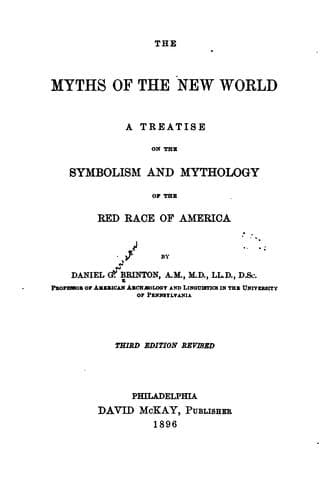
The Myths of the New World: A Treatise on the Symbolism and Mythology of the Red Race of AmericaBrinton, Daniel G. (Daniel Garrison)
Religion
The Myths of the New World: A Treatise on the Symbolism and Mythology of the Red Race of America
Brinton, Daniel G. (Daniel Garrison)
Indian mythology; Indians -- Folklore
What these materials were has been shown in the last few chapters. A
simple primitive substance, a divinity to mould it--these are the
requirements of every cosmogony. Concerning the first no nation ever
hesitated. All agree that before time began _water_ held all else in
solution, covered and concealed everything. The reasons for this assumed
priority of water have been already touched upon. Did a tribe dwell near
some great sea others can be imagined. The land is limited, peopled,
stable; the ocean fluctuating, waste, boundless. It insatiably swallows
all rains and rivers, quenches sun and moon in its dark chambers, and
raves against its bounds as a beast of prey. Awe and fear are the
sentiments it inspires; in Aryan tongues its synonyms are the _desert_
and the _night_.[194-1] It produces an impression of immensity,
infinity, formlessness, and barren changeableness, well suited to a
notion of chaos. It is sterile, receiving all things, producing nothing.
Hence the necessity of a creative power to act upon it, as it were to
impregnate its barren germs. Some cosmogonies find this in one, some in
another personification of divinity. Commonest of all is that of the
wind, or its emblem the bird, types of the breath of life.
Thus the venerable record in Genesis, translated in the authorized
version "and the Spirit of God moved on the face of the waters," may
with equal correctness be rendered "and a mighty wind brooded on the
surface of the waters," presenting the picture of a primeval ocean
fecundated by the wind as a bird.[195-1] The eagle that in the Finnish
epic of Kalewala floated over the waves and hatched the land, the egg
that in Chinese legend swam hither and thither until it grew to a
continent, the giant Ymir, the rustler (as wind in trees), from whose
flesh, says the Edda, our globe was made and set to float like a speck
in the vast sea between Muspel and Niflheim, all are the same tale
repeated by different nations in different ages. But why take
illustrations from the old world when they are so plenty in the new?
Before the creation, said the Muscogees, a great body of water was alone
visible. Two pigeons flew to and fro over its waves, and at last spied a
blade of grass rising above the surface. Dry land gradually followed,
and the islands and continents took their present shapes.[195-2] Whether
this is an authentic aboriginal myth, is not beyond question. No such
doubt attaches to that of the Athapascas. With singular unanimity, most
of the northwest branches of this stock trace their descent from a
raven, "a mighty bird, whose eyes were fire, whose glances were
lightning, and the clapping of whose wings was thunder. On his descent
to the ocean, the earth instantly rose, and remained on the surface of
the water. This omnipotent bird then called forth all the variety of
animals."[196-1]
Very similar, but with more of poetic finish, is the legend of the
Quichés:--
Public-domain text, read in full here on John Shaqi.
Reviews
Reviews
No reviews yet
Be the first to share your thoughts on this work.
Elsewhere in the archive
Join the Discussion
Join the discussion
Sign in to leave a comment or review.
Sign InorCreate an account