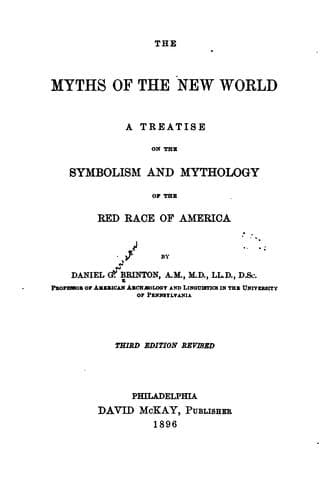
The Myths of the New World: A Treatise on the Symbolism and Mythology of the Red Race of AmericaBrinton, Daniel G. (Daniel Garrison)
Religion
The Myths of the New World: A Treatise on the Symbolism and Mythology of the Red Race of America
Brinton, Daniel G. (Daniel Garrison)
Indian mythology; Indians -- Folklore
This exhausts the list. All other methods of writing, the hieroglyphs of
the Micmacs of Acadia, the syllabic alphabet of the Cherokees, the
pretended traces of Greek, Hebrew, and Celtiberic letters which have
from time to time been brought to the notice of the public, have been
without exception the products of foreign civilization or simply frauds.
Not a single coin, inscription, or memorial of any kind whatever, has
been found on the American continent showing the existence, either
generally or locally, of any other means of writing than those
specified.
Poor as these substitutes for a developed phonetic system seem to us,
they were of great value to the uncultivated man. In his legends their
introduction is usually ascribed to some heaven-sent benefactor, the
antique characters were jealously adhered to, and the pictured scroll of
bark, the quipu ball, the belt of wampum, were treasured with provident
care, and their import minutely expounded to the most intelligent of the
rising generation. In all communities beyond the stage of barbarism a
class of persons was set apart for this duty and no other. Thus, for
example, in ancient Peru, one college of priests styled _amauta_,
learned, had exclusive charge over the quipus containing the
mythological and historical traditions; a second, the _haravecs_,
singers, devoted themselves to those referring to the national ballads
and dramas; while a third occupied their time solely with those
pertaining to civil affairs. Such custodians preserved and prepared the
archives, learned by heart with their aid what their fathers knew, and
in some countries, as, for instance, among the Panos mentioned above,
and the Quiches of Guatemala,[16-1] repeated portions of them at times
to the assembled populace. It has even been averred by one of their
converted chiefs, long a missionary to his fellows, that the Chipeways
of Lake Superior have a college composed of ten "of the wisest and most
venerable of their nation," who have in charge the pictured records
containing the ancient history of their tribe. These are kept in an
underground chamber, and are disinterred every fifteen years by the
assembled guardians, that they may be repaired, and their contents
explained to new members of the society.[17-1]
Public-domain text, read in full here on John Shaqi.
Reviews
Reviews
No reviews yet
Be the first to share your thoughts on this work.
Join the Discussion
Join the discussion
Sign in to leave a comment or review.
Sign InorCreate an account