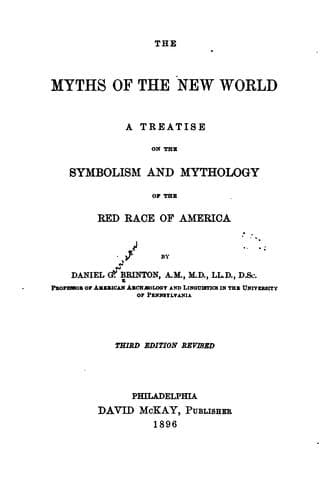
The Myths of the New World: A Treatise on the Symbolism and Mythology of the Red Race of AmericaBrinton, Daniel G. (Daniel Garrison)
Religion
The Myths of the New World: A Treatise on the Symbolism and Mythology of the Red Race of America
Brinton, Daniel G. (Daniel Garrison)
Indian mythology; Indians -- Folklore
In spite of these precautions, the end seems to have been very
imperfectly attained. The most distinguished characters, the weightiest
events in national history faded into oblivion after a few generations.
The time and circumstances of the formation of the league of the Five
Nations, the dispersion of the mound builders of the Ohio valley in the
fifteenth century, the chronicles of Peru or Mexico beyond a century or
two anterior to the conquest, are preserved in such a vague and
contradictory manner that they have slight value as history. Their
mythology fared somewhat better, for not only was it kept fresh in the
memory by frequent repetition; but being itself founded in nature, it
was constantly nourished by the truths which gave it birth.
Nevertheless, we may profit by the warning to remember that their myths
are myths only, and not the reflections of history or heroes.
Rising from these details to a general comparison of the symbolic and
phonetic systems in their reactions on the mind, the most obvious are
their contrasted effects on the faculty of memory. Letters represent
elementary sounds, which are few in any language, while symbols stand
for ideas, and they are numerically infinite. The transmission of
knowledge by means of the latter is consequently attended with most
disproportionate labor. It is almost as if we could quote nothing from
an author unless we could recollect his exact words. We have a right to
look for excellent memories where such a mode is in vogue, and in the
present instance we are not disappointed. "These savages," exclaims La
Hontan, "have the happiest memories in the world!" It was etiquette at
their councils for each speaker to repeat verbatim all his predecessors
had said, and the whites were often astonished and confused at the
verbal fidelity with which the natives recalled the transactions of long
past treaties. Their songs were inexhaustible. An instance is on record
where an Indian sang two hundred on various subjects.[18-1] Such a fact
reminds us of a beautiful expression of the elder Humboldt: "Man," he
says, "regarded as an animal, belongs to one of the singing species; but
his notes are always associated with ideas." The youth who were educated
at the public schools of ancient Mexico--for that realm, so far from
neglecting the cause of popular education, established houses for
gratuitous instruction, and to a certain extent made the attendance upon
them obligatory--learned by rote long orations, poems, and prayers with
a facility astonishing to the conquerors, and surpassing anything they
were accustomed to see in the universities of Old Spain. A phonetic
system actually weakens the retentive powers of the mind by offering a
more facile plan for preserving thought. "_Ce que je mets sur papier, je
remets de ma mémoire_" is an expression of old Montaigne which he could
never have used had he employed ideographic characters.
Public-domain text, read in full here on John Shaqi.
Reviews
Reviews
No reviews yet
Be the first to share your thoughts on this work.
Join the Discussion
Join the discussion
Sign in to leave a comment or review.
Sign InorCreate an account