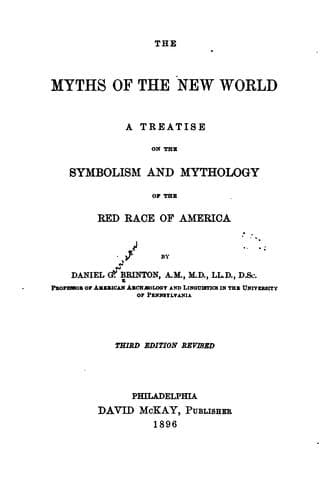
The Myths of the New World: A Treatise on the Symbolism and Mythology of the Red Race of AmericaBrinton, Daniel G. (Daniel Garrison)
Religion
The Myths of the New World: A Treatise on the Symbolism and Mythology of the Red Race of America
Brinton, Daniel G. (Daniel Garrison)
Indian mythology; Indians -- Folklore
The same terror inspired the Peruvians at every eclipse, for some day,
taught the Amautas, the shadow will veil the sun forever, and land,
moon, and stars will be wrapt in the vortex of a devouring conflagration
to know no regeneration; or a drought will wither every herb of the
field, suck up the waters, and leave the race to perish to the last
creature; or the moon will fall from her place in the heavens and
involve all things in her own ruin, a figure of speech meaning that the
waters would submerge the land.[220-1] In that dreadful day, thought
the Algonkins, when in anger Michabo will send a mortal pestilence to
destroy the nations, or, stamping his foot on the ground, flames will
burst forth to consume the habitable land, only a pair, or only, at
most, those who have maintained inviolate the institutions he ordained,
will he protect and preserve to inhabit the new world he will then
fabricate. Therefore they do not speak of this catastrophe as the end of
the world, but use one of those nice grammatical distinctions so
frequent in American aboriginal languages and which can only be
imitated, not interpreted, in ours, signifying "when it will be near its
end," "when it will no longer be available for man."[220-2]
An ancient prophecy handed down from their ancestors warns the
Winnebagoes that their nation shall be annihilated at the close of the
thirteenth generation. Ten have already passed, and that now living has
appointed ceremonies to propitiate the powers of heaven, and mitigate
its stern decree.[220-3] Well may they be about it, for there is a
gloomy probability that the warning came from no false prophet. Few
tribes were destitute of such presentiments. The Chikasaw, the Mandans
of the Missouri, the Pueblo Indians of New Mexico, the Muyscas of
Bogota, the Botocudos of Brazil, the Araucanians of Chili, have been
asserted on testimony that leaves no room for scepticism, to have
entertained such forebodings from immemorial time. Enough for the
purpose if the list is closed with the prediction of a Maya priest,
cherished by the inhabitants of Yucatan long before the Spaniard
desolated their stately cities. It is one of those preserved by Father
Lizana, curé of Itzamal, and of which he gives the original. Other
witnesses inform us that this nation "had a tradition that the world
would end,"[221-1] and probably, like the Greeks and Aztecs, they
supposed the gods would perish with it.
"At the close of the ages, it hath been decreed,
Shall perish and vanish each weak god of men,
And the world shall be purged with a ravening fire.
Happy the man in that terrible day,
Who bewails with contrition the sins of his life,[221-2]
And meets without flinching the fiery ordeal."
FOOTNOTES:
Public-domain text, read in full here on John Shaqi.
Reviews
Reviews
No reviews yet
Be the first to share your thoughts on this work.
Elsewhere in the archive
Join the Discussion
Join the discussion
Sign in to leave a comment or review.
Sign InorCreate an account