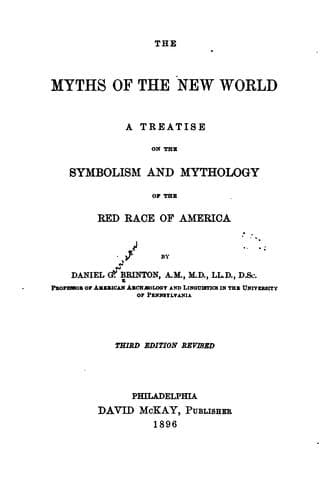
The Myths of the New World: A Treatise on the Symbolism and Mythology of the Red Race of AmericaBrinton, Daniel G. (Daniel Garrison)
Religion
The Myths of the New World: A Treatise on the Symbolism and Mythology of the Red Race of America
Brinton, Daniel G. (Daniel Garrison)
Indian mythology; Indians -- Folklore
Man is indeed like the grass that springs up and soon withers away; but
he is also more than this. The quintessence of dust, he is a son of the
gods as well as a son of the soil. He is the direct product of the great
creative power; therefore all the Athapascan tribes west of the Rocky
Mountains--the Kenai, the Kolushes, and the Atnai--claim descent from a
raven--from that same mighty cloud-bird, who in the beginning of things
seized the elements and brought the world from the abyss of the
primitive ocean. Those of the same stock situate more eastwardly, the
Dogribs, the Chepewyans, the Hare Indians, and also the west coast
Eskimos, and the natives of the Aleutian Isles, all believe that they
have sprung from a dog.[229-2] The latter animal, we have already seen,
both in the old and new world was the fixed symbol of the water goddess.
Therefore in these myths, which are found over so many thousand square
leagues, we cannot be in error in perceiving a reflex of their
cosmogonical traditions already discussed, in which from the winds and
the waters, represented here under their emblems of the bird and the
dog, all animate life proceeded.
Without this symbolic coloring, a tribe to the south of them, a band of
the Minnetarees, had the crude tradition that their first progenitor
emerged from the waters, bearing in his hand an ear of maize,[230-1]
very much as Viracocha and his companions rose from the sacred waves of
Lake Titicaca, or as the Moxos imagined that they were descended from
the lakes and rivers on whose banks their villages were situated.
These myths, and many others, hint of general conceptions of life and
the world, wide-spread theories of ancient date, such as we are not
accustomed to expect among savage nations, such as may very excusably
excite a doubt as to their native origin, but a doubt infallibly
dispelled by a careful comparison of the best authorities. Is it that
hitherto, in the pride of intellectual culture, we have never done
justice to the thinking faculty of those whom we call barbarians? Or
shall we accept the only other alternative, that these are the
unappreciated heirlooms bequeathed a rude race by a period of higher
civilization, long since extinguished by constant wars and ceaseless
fear? We are not yet ready to answer these questions. With almost
unanimous consent the latter has been accepted as the true solution, but
rather from the preconceived theory of a state of primitive
civilization from which man fell, than from ascertained facts.
Public-domain text, read in full here on John Shaqi.
Reviews
Reviews
No reviews yet
Be the first to share your thoughts on this work.
Elsewhere in the archive
Join the Discussion
Join the discussion
Sign in to leave a comment or review.
Sign InorCreate an account