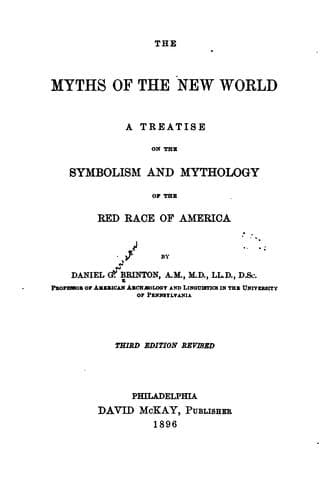
The Myths of the New World: A Treatise on the Symbolism and Mythology of the Red Race of AmericaBrinton, Daniel G. (Daniel Garrison)
Religion
The Myths of the New World: A Treatise on the Symbolism and Mythology of the Red Race of America
Brinton, Daniel G. (Daniel Garrison)
Indian mythology; Indians -- Folklore
It would, perhaps, be pushing symbolism too far to explain as an emblem
of the primitive waters the coyote, which, according to the Root-Diggers
of California, brought their ancestors into the world; or the wolf,
which the Lenni Lenape pretended released mankind from the dark bowels
of the earth by scratching away the soil. They should rather be
interpreted by the curious custom of the Toukaways, a wild people in
Texas, of predatory and unruly disposition. They celebrate their origin
by a grand annual dance. One of them, naked as he was born, is buried in
the earth. The others, clothed in wolf-skins, walk over him, snuff
around him, howl in lupine style, and finally dig him up with their
nails. The leading wolf then solemnly places a bow and arrow in his
hands, and to his inquiry as to what he must do for a living, paternally
advises him "to do as the wolves do--rob, kill, and murder, rove from
place to place, and never cultivate the soil."[231-1] Most wise and
fatherly counsel! But what is there new under the sun? Three thousand
years ago the Hirpini, or Wolves, an ancient Sabine tribe, were wont to
collect on Mount Soracte, and there go through certain rites in memory
of an oracle which predicted their extinction when they ceased to gain
their living as wolves by violence and plunder. Therefore they dressed
in wolf-skins, ran with barks and howls over burning coals, and gnawed
wolfishly whatever they could seize.[231-2]
Though hasty writers have often said that the Indian tribes claim
literal descent from different wild beasts, probably in all other
instances, as in these, this will prove, on examination, to be an error
resting on a misapprehension arising from the habit of the natives of
adopting as their totem or clan-mark the figure and name of some animal,
or else, in an ignorance of the animate symbols employed with such
marked preference by the red race to express abstract ideas. In some
cases, doubtless, the natives themselves came, in time, to confound the
symbol with the idea, by that familiar process of personification and
consequent debasement exemplified in the history of every religion; but
I do not believe that a single example could be found where an Indian
tribe had a tradition whose real purport was that man came by natural
process of descent from an ancestor, a brute.
The reflecting mind will not be offended at the contradictions in these
different myths, for a myth is, in one sense, a theory of natural
phenomena expressed in the form of a narrative. Often several
explanations seem equally satisfactory for the same fact, and the mind
hesitates to choose, and rather accepts them all than rejects any. Then,
again, an expression current as a metaphor by-and-by crystallizes into a
dogma, and becomes the nucleus of a new mythological growth. These are
familiar processes to one versed in such studies, and involve no logical
contradiction, because they are never required to be reconciled.
FOOTNOTES:
Public-domain text, read in full here on John Shaqi.
Reviews
Reviews
No reviews yet
Be the first to share your thoughts on this work.
Elsewhere in the archive
Join the Discussion
Join the discussion
Sign in to leave a comment or review.
Sign InorCreate an account