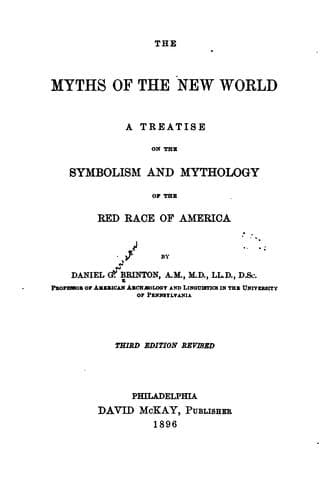
The Myths of the New World: A Treatise on the Symbolism and Mythology of the Red Race of America — John Shaqi
The Myths of the New World: A Treatise on the Symbolism and Mythology of the Red Race of AmericaBrinton, Daniel G. (Daniel Garrison)
Religion
The Myths of the New World: A Treatise on the Symbolism and Mythology of the Red Race of America
Brinton, Daniel G. (Daniel Garrison)
Indian mythology; Indians -- Folklore
The one is his _isolation_. Cut off time out of mind from the rest of
the world, he never underwent those crossings of blood and culture which
so modified and on the whole promoted the growth of the old world
nationalities. In his own way he worked out his own destiny, and what he
won was his with a more than ordinary right of ownership. For all those
old dreams of the advent of the Ten Lost Tribes, of Buddhist priests, of
Welsh princes, or of Phenician merchants on American soil, and there
exerting a permanent influence, have been consigned to the dustbin by
every unbiased student, and when we see such men as Mr. Schoolcraft and
the Abbé E. C. Brasseur essaying to resuscitate them, we regretfully
look upon it in the light of a literary anachronism.
The second trait is the entire absence of the herdsman's life with its
softening associations. Throughout the continent there is not a single
authentic instance of a pastoral tribe, not one of an animal raised for
its milk,[21-1] nor for the transportation of persons, and very few for
their flesh. It was essentially a hunting race. The most civilized
nations looked to the chase for their chief supply of meat, and the
courts of Cuzco and Mexico enacted stringent game and forest laws, and
at certain periods the whole population turned out for a general crusade
against the denizens of the forest. In the most densely settled
districts the conquerors found vast stretches of primitive woods.
If we consider the life of a hunter, pitting his skill and strength
against the marvellous instincts and quick perceptions of the brute,
training his senses to preternatural acuteness, but blunting his more
tender feelings, his sole aim to shed blood and take life, dependent on
luck for his food, exposed to deprivations, storms, and long
wanderings, his chief diet flesh, we may more readily comprehend that
conspicuous disregard of human suffering, those sanguinary rites, that
vindictive spirit, that inappeasable restlessness, which we so often
find in the chronicles of ancient America. The law with reason objects
to accepting a butcher as a juror on a trial for life; here is a whole
race of butchers.
Public-domain text, read in full here on John Shaqi.
Reviews
Reviews
No reviews yet
Be the first to share your thoughts on this work.
Join the Discussion
Join the discussion
Sign in to leave a comment or review.
Sign InorCreate an account