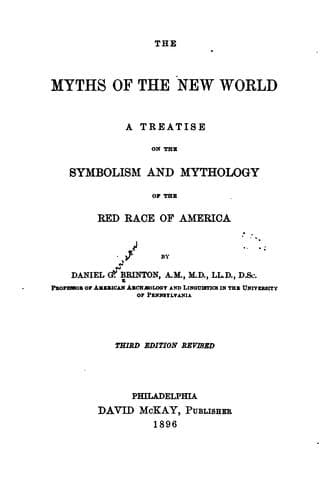
The Myths of the New World: A Treatise on the Symbolism and Mythology of the Red Race of AmericaBrinton, Daniel G. (Daniel Garrison)
Religion
The Myths of the New World: A Treatise on the Symbolism and Mythology of the Red Race of America
Brinton, Daniel G. (Daniel Garrison)
Indian mythology; Indians -- Folklore
The one mollifying element was agriculture. On the altar of Mixcoatl,
god of hunting, the Aztec priest tore the heart from the human victim
and smeared with the spouting blood the snake that coiled its lengths
around the idol; flowers and fruits, yellow ears of maize and clusters
of rich bananas decked the shrine of Centeotl, beneficent patroness of
agriculture, and bloodless offerings alone were her appropriate dues.
This shows how clear, even to the native mind, was the contrast between
these two modes of subsistence. By substituting a sedentary for a
wandering life, by supplying a fixed dependence for an uncertain
contingency, and by admonishing man that in preservation, not in
destruction, lies his most remunerative sphere of activity, we can
hardly estimate too highly the wide distribution of the zea mays. This
was their only cereal, and it was found in cultivation from the southern
extremity of Chili to the fiftieth parallel of north latitude, beyond
which limits the low temperature renders it an uncertain crop. In their
legends it is represented as the gift of the Great Spirit (Chipeways),
brought from the terrestrial Paradise by the sacred animals (Quiches),
and symbolically the mother of the race (Nahuas), and the material from
which was moulded the first of men (Quiches).
As the races, so the great families of man who speak dialects of the
same tongue are, in a sense, individuals, bearing each its own
physiognomy. When the whites first heard the uncouth gutturals of the
Indians, they frequently proclaimed that hundreds of radically diverse
languages, invented, it was piously suggested, by the Devil for the
annoyance of missionaries, prevailed over the continent. Earnest
students of such matters--Vater, Duponceau, Gallatin, and
Buschmann--have, however, demonstrated that nine-tenths of the area of
America, at its discovery, were occupied by tribes using dialects
traceable to ten or a dozen primitive stems. The names of these, their
geographical position in the sixteenth century, and, so far as it is
safe to do so, their individual character, I shall briefly mention.
Public-domain text, read in full here on John Shaqi.
Reviews
Reviews
No reviews yet
Be the first to share your thoughts on this work.
Join the Discussion
Join the discussion
Sign in to leave a comment or review.
Sign InorCreate an account