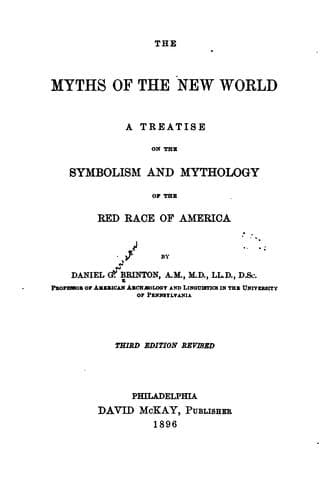
The Myths of the New World: A Treatise on the Symbolism and Mythology of the Red Race of AmericaBrinton, Daniel G. (Daniel Garrison)
Religion
The Myths of the New World: A Treatise on the Symbolism and Mythology of the Red Race of America
Brinton, Daniel G. (Daniel Garrison)
Indian mythology; Indians -- Folklore
But man cannot trample with impunity on the laws of his physical life,
and the consequences of these deprivations and morbid excitements of the
brain show themselves in terrible pictures. Not unfrequently they were
carried to the pitch of raving mania, reminding one of the worst forms
of the Berserker fury of the Scandinavians, or the Bacchic rage of
Greece. The enthusiast, maddened with the fancies of a disordered
intellect, would start forth from his seclusion in an access of demoniac
frenzy. Then woe to the dog, the child, the slave, or the woman who
crossed his path; for nothing but blood could satisfy his inappeasable
craving, and they fell instant victims to his madness. But were it a
strong man, he bared his arm, and let the frenzied hermit bury his teeth
in the quivering flesh. Such is a scene at this day not uncommon on the
northwest coast, and few of the natives around Milbank Sound are without
the scars the result of this horrid custom.[275-1]
This frenzy, terrible enough in individuals, had its most disastrous
effects when with that peculiar facility of contagion which marks
hysterical maladies, it swept through whole villages, transforming them
into bedlams filled with unrestrained madmen. Those who have studied the
strange and terrible mental epidemics that visited Europe in the middle
ages, such as the tarantula dance of Apulia, the chorea Germanorum, and
the great St. Vitus' dance, will be prepared to appreciate the nature of
a scene at a Huron village, described by Father le Jeune in 1639. A
festival of three days and three nights had been in progress to relieve
a woman who, from the description, seems to have been suffering from
some obscure nervous complaint. Toward the close of this vigil, which
throughout was marked by all sorts of debaucheries and excesses, all the
participants seemed suddenly seized by ten thousand devils. They ran
howling and shrieking through the town, breaking everything destructible
in the cabins, killing dogs, beating the women and children, tearing
their garments, and scattering the fires in every direction with bare
hands and feet. Some of them dropped senseless, to remain long or
permanently insane, but the others continued until worn out with
exhaustion. The Father learned that during these orgies not unfrequently
whole villages were consumed, and the total extirpation of some families
had resulted. No wonder that he saw in them the diabolical workings of
the prince of evil, but the physician is rather inclined to class them
with those cases of epidemic hysteria, the common products of violent
and ill-directed mental stimuli.[276-1]
Public-domain text, read in full here on John Shaqi.
Reviews
Reviews
No reviews yet
Be the first to share your thoughts on this work.
Elsewhere in the archive
Join the Discussion
Join the discussion
Sign in to leave a comment or review.
Sign InorCreate an account