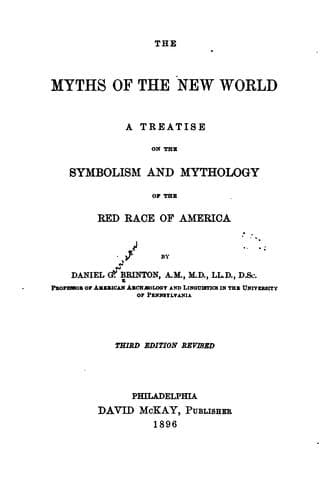
The Myths of the New World: A Treatise on the Symbolism and Mythology of the Red Race of AmericaBrinton, Daniel G. (Daniel Garrison)
Religion
The Myths of the New World: A Treatise on the Symbolism and Mythology of the Red Race of America
Brinton, Daniel G. (Daniel Garrison)
Indian mythology; Indians -- Folklore
These various considerations prove beyond a doubt that the power of the
priesthood did by no means rest exclusively on deception. They indorse
and explain the assertions of converted natives, that their power as
prophets was something real, and entirely inexplicable to themselves.
And they make it easily understood how those missionaries failed who
attempted to persuade them that all this boasted power was false. More
correct views than these ought to have been suggested by the facts
themselves, for it is indisputable that these magicians did not
hesitate at times to test their strength on each other. In these strange
duels _à l'outrance_, one would be seated opposite his antagonist,
surrounded with the mysterious emblems of his craft, and call upon his
gods one after another to strike his enemy dead. Sometimes one,
"gathering his medicine," as it was termed, feeling within himself that
hidden force of will which makes itself acknowledged even without words,
would rise in his might, and in a loud and severe voice command his
opponent to die! Straightway the latter would drop dead, or yielding in
craven fear to a superior volition, forsake the implements of his art,
and with an awful terror at his heart, creep to his lodge, refuse all
nourishment, and presently perish. Still more terrible was the tyranny
they exerted on the superstitious minds of the masses. Let an Indian
once be possessed of the idea that he is bewitched, and he will probably
reject all food, and sink under the phantoms of his own fancy.
How deep the superstitious veneration of these men has struck its roots
in the soul of the Indian, it is difficult for civilized minds to
conceive. Their power is currently supposed to be without any bounds,
"extending to the raising of the dead and the control of all laws of
nature."[277-1] The grave offers no escape from their omnipotent arms.
The Sacs and Foxes, Algonkin tribes, think that the soul cannot leave
the corpse until set free by the medicine men at their great annual
feast;[277-2] and the Puelches of Buenos Ayres guard a profound silence
as they pass by the tomb of some redoubted necromancer, lest they should
disturb his repose, and suffer from his malignant skill.[278-1]
Public-domain text, read in full here on John Shaqi.
Reviews
Reviews
No reviews yet
Be the first to share your thoughts on this work.
Elsewhere in the archive
Join the Discussion
Join the discussion
Sign in to leave a comment or review.
Sign InorCreate an account