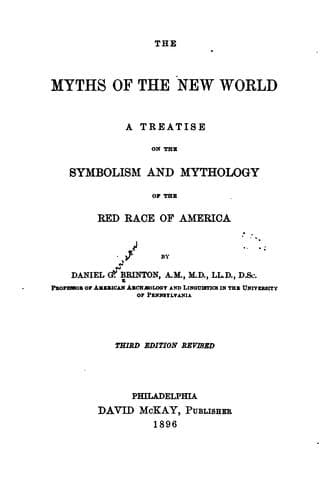
The Myths of the New World: A Treatise on the Symbolism and Mythology of the Red Race of AmericaBrinton, Daniel G. (Daniel Garrison)
Religion
The Myths of the New World: A Treatise on the Symbolism and Mythology of the Red Race of America
Brinton, Daniel G. (Daniel Garrison)
Indian mythology; Indians -- Folklore
While thus investigating their real and supposed power over the physical
and mental world, their strictly priestly functions, as performers of
the rites of religion, have not been touched upon. Among the ruder
tribes these, indeed, were of the most rudimentary character.
Sacrifices, chiefly in the form of feasts, where every one crammed to
his utmost, dances, often winding up with the wildest scenes of
licentiousness, the repetition of long and monotonous chants, the making
of the new fire, these are the ceremonies that satisfy the religious
wants of savages. The priest finds a further sphere for his activity in
manufacturing and consecrating amulets to keep off ill luck, in
interpreting dreams, and especially in lifting the veil of the future.
In Peru, for example, they were divided into classes, who made the
various means of divination specialties. Some caused the idols to speak,
others derived their foreknowledge from words spoken by the dead, others
predicted by leaves of tobacco or the grains and juice of cocoa, while
to still other classes, the shapes of grains of maize taken at random,
the appearance of animal excrement, the forms assumed by the smoke
rising from burning victims, the entrails and viscera of animals, the
course taken by a certain species of spider, the visions seen in
drunkeness,[TN-16] the flights of birds, and the directions in which
fruits would fall, all offered so many separate fields of
prognostication, the professors of which were distinguished by different
ranks and titles.[279-1]
As the intellectual force of the nation was chiefly centred in this
class, they became the acknowledged depositaries of its sacred legends,
the instructors in the art of preserving thought; and from their duty to
regulate festivals, sprang the observation of the motions of the
heavenly bodies, the adjustment of the calendars, and the pseudo-science
of judicial astrology. The latter was carried to as subtle a pitch of
refinement in Mexico as in the old world; and large portions of the
ancient writers are taken up with explaining the method adopted by the
native astrologers to cast the horoscope, and reckon the nativity of the
newly-born infant.
Public-domain text, read in full here on John Shaqi.
Reviews
Reviews
No reviews yet
Be the first to share your thoughts on this work.
Elsewhere in the archive
Join the Discussion
Join the discussion
Sign in to leave a comment or review.
Sign InorCreate an account