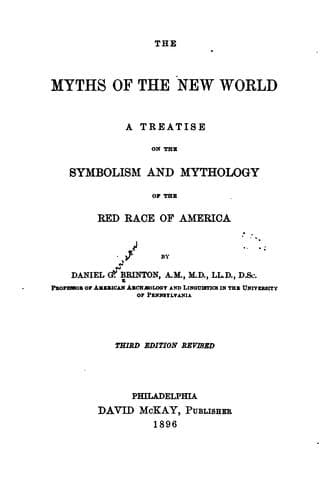
The Myths of the New World: A Treatise on the Symbolism and Mythology of the Red Race of AmericaBrinton, Daniel G. (Daniel Garrison)
Religion
The Myths of the New World: A Treatise on the Symbolism and Mythology of the Red Race of America
Brinton, Daniel G. (Daniel Garrison)
Indian mythology; Indians -- Folklore
Best known to us of all the Indians are the Algonkins and Iroquois, who,
at the time of the discovery, were the sole possessors of the region now
embraced by Canada and the eastern United States north of the
thirty-fifth parallel. The latter, under the names of the Five Nations,
Hurons, Tuscaroras, Susquehannocks, Nottoways and others, occupied much
of the soil from the St. Lawrence and Lake Ontario to the Roanoke, and
perhaps the Cherokees, whose homes were in the secluded vales of East
Tennessee, were one of their early offshoots.[25-3] They were a race of
warriors, courageous, cruel, unimaginative, but of rare political
sagacity. They are more like ancient Romans than Indians, and are leading
figures in the colonial wars.
The Algonkins surrounded them on every side, occupying the rest of the
region mentioned and running westward to the base of the Rocky
Mountains, where one of their famous bands, the Blackfeet, still hunts
over the valley of the Saskatchewan. They were more genial than the
Iroquois, of milder manners and more vivid fancy, and were regarded by
these with a curious mixture of respect and contempt. Some writer has
connected this difference with their preference for the open prairie
country in contrast to the endless and sombre forests where were the
homes of the Iroquois. Their history abounds in great men, whose
ambitious plans were foiled by the levity of their allies and their want
of persistence. They it was who under King Philip fought the Puritan
fathers; who at the instigation of Pontiac doomed to death every white
trespasser on their soil; who led by Tecumseh and Black Hawk gathered
the clans of the forest and mountain for the last pitched battle of the
races in the Mississippi valley. To them belonged the mild mannered
Lenni Lenape, who little foreboded the hand of iron that grasped their
own so softly under the elm tree of Shackamaxon, to them the restless
Shawnee, the gypsy of the wilderness, the Chipeways of Lake Superior,
and also to them the Indian girl Pocahontas, who in the legend averted
from the head of the white man the blow which, rebounding, swept away
her father and all his tribe.[27-1]
Public-domain text, read in full here on John Shaqi.
Reviews
Reviews
No reviews yet
Be the first to share your thoughts on this work.
Join the Discussion
Join the discussion
Sign in to leave a comment or review.
Sign InorCreate an account