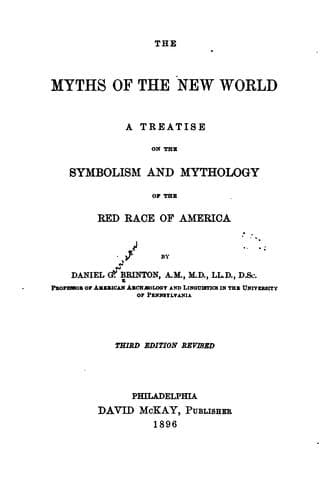
The Myths of the New World: A Treatise on the Symbolism and Mythology of the Red Race of America — John Shaqi
The Myths of the New World: A Treatise on the Symbolism and Mythology of the Red Race of AmericaBrinton, Daniel G. (Daniel Garrison)
Religion
The Myths of the New World: A Treatise on the Symbolism and Mythology of the Red Race of America
Brinton, Daniel G. (Daniel Garrison)
Indian mythology; Indians -- Folklore
Fringing the shores of the Northern Ocean from Mount St. Elias on the
west to the Gulf of St. Lawrence on the east, rarely seen a hundred
miles from the coast, were the Eskimos.[23-1] They are the connecting
link between the races of the Old and New Worlds, in physical appearance
and mental traits more allied to the former, but in language betraying
their near kinship to the latter. An amphibious race, born fishermen, in
their buoyant skin kayaks they brave fearlessly the tempests, make long
voyages, and merit the sobriquet bestowed upon them by Von Baer, "the
Phenicians of the north." Contrary to what one might suppose, they are,
amid their snows, a contented, light-hearted people, knowing no longing
for a sunnier clime, given to song, music, and merry tales. They are
cunning handicraftsmen to a degree, but withal wholly ingulfed in a
sensuous existence. The desperate struggle for life engrosses them, and
their mythology is barren.
South of them, extending in a broad band across the continent from
Hudson's Bay to the Pacific, and almost to the Great Lakes below, is the
Athapascan stock. Its affiliated tribes rove far north to the mouth of
the Mackenzie River, and wandering still more widely in an opposite
direction along both declivities of the Rocky Mountains, people portions
of the coast of Oregon south of the mouth of the Columbia, and spreading
over the plains of New Mexico under the names of Apaches, Navajos, and
Lipans, almost reach the tropics at the delta of the Rio Grande del
Norte, and on the shores of the Gulf of California. No wonder they
deserted their fatherland and forgot it altogether, for it is a very
_terra damnata_, whose wretched inhabitants are cut off alike from the
harvest of the sea and the harvest of the soil. The profitable culture of
maize does not extend beyond the fiftieth parallel of latitude, and less
than seven degrees farther north the mean annual temperature everywhere
east of the mountains sinks below the freezing point.[25-1] Agriculture
is impossible, and the only chance for life lies in the uncertain
fortunes of the chase and the penurious gifts of an arctic flora. The
denizens of these wilds are abject, slovenly, hopelessly savage, "at the
bottom of the scale of humanity in North America," says Dr. Richardson,
and their relatives who have wandered to the more genial climes of the
south are as savage as they, as perversely hostile to a sedentary life,
as gross and narrow in their moral notions. This wide-spread stock,
scattered over forty-five degrees of latitude, covering thousands of
square leagues, reaching from the Arctic Ocean to the confines of the
empire of the Montezumas, presents in all its subdivisions the same
mental physiognomy and linguistic peculiarities.[25-2]
Public-domain text, read in full here on John Shaqi.
Reviews
Reviews
No reviews yet
Be the first to share your thoughts on this work.
Join the Discussion
Join the discussion
Sign in to leave a comment or review.
Sign InorCreate an account