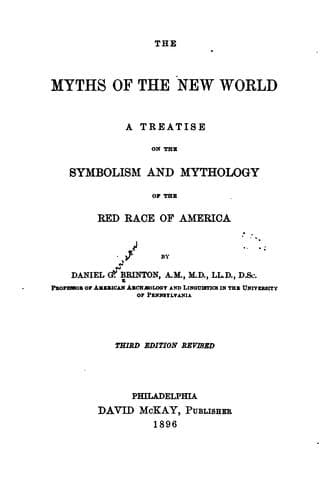
The Myths of the New World: A Treatise on the Symbolism and Mythology of the Red Race of AmericaBrinton, Daniel G. (Daniel Garrison)
Religion
The Myths of the New World: A Treatise on the Symbolism and Mythology of the Red Race of America
Brinton, Daniel G. (Daniel Garrison)
Indian mythology; Indians -- Folklore
the mountains of Vera Paz rose to a civilization that rivalled that of
the Montezumas, while others remained in utter barbarism in the far
north.
The Aztecs not only conquered a Maya colony, and founded the empire of
the Quiches in Central America, a complete body of whose mythology has
been brought to light in late years, but seem to have made a marked
imprint on the Mayas themselves. These possessed, as has already been
said, the peninsula of Yucatan. There is some reason to suppose they
came thither originally from the Greater Antilles, and none to doubt but
that the Huastecas who lived on the river Panuco and the Natchez of
Louisiana were offshoots from them. Their language is radically distinct
from that of the Aztecs, but their calendar and a portion of their
mythology are common property. They seem an ancient race of mild manners
and considerable polish. No American nation offers a more promising
field for study. Their stone temples still bear testimony to their
uncommon skill in the arts. A trustworthy tradition dates the close of
the golden age of Yucatan a century anterior to its discovery by
Europeans. Previously it had been one kingdom, under one ruler, and
prolonged peace had fostered the growth of the fine arts; but when
their capital Mayapan fell, internal dissensions ruined most of their
cities.
No connection whatever has been shown between the civilization of North
and South America. In the latter continent it was confined to two
totally foreign tribes, the Muyscas, whose empire, called that of the
Zacs, was in the neighborhood of Bogota, and the Peruvians, who in their
two related divisions of Quichuas and Aymaras extended their language
and race along the highlands of the Cordilleras from the equator to the
thirtieth degree of south latitude. Lake Titicaca seems to have been the
cradle of their civilization, offering another example how inland seas
and well-watered plains favor the change from a hunting to an
agricultural life. These four nations, the Aztecs, the Mayas, the
Muyscas and the Peruvians, developed spontaneously and independently
under the laws of human progress what civilization was found among the
red race. They owed nothing to Asiatic or European teachers. The Incas
it was long supposed spoke a language of their own, and this has been
thought evidence of foreign extraction; but Wilhelm von Humboldt has
shown conclusively that it was but a dialect of the common tongue of
their country.[31-1]
Public-domain text, read in full here on John Shaqi.
Reviews
Reviews
No reviews yet
Be the first to share your thoughts on this work.
Join the Discussion
Join the discussion
Sign in to leave a comment or review.
Sign InorCreate an account