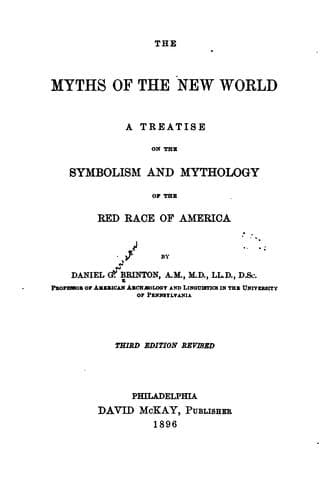
The Myths of the New World: A Treatise on the Symbolism and Mythology of the Red Race of AmericaBrinton, Daniel G. (Daniel Garrison)
Religion
The Myths of the New World: A Treatise on the Symbolism and Mythology of the Red Race of America
Brinton, Daniel G. (Daniel Garrison)
Indian mythology; Indians -- Folklore
When Columbus first touched the island of Cuba, he was regaled with
horrible stories of one-eyed monsters who dwelt on the other islands,
but plundered indiscriminately on every hand. These turned out to be the
notorious Caribs, whose other name, _Cannibals_, has descended as a
common noun to our language, expressive of one of their inhuman
practices. They had at that time seized many of the Antilles, and had
gained a foothold on the coast of Honduras and Darien, but pointed for
their home to the mainland of South America. This they possessed along
the whole northern shore, inland at least as far as the south bank of
the Amazon, and west nearly to the Cordilleras. It is still an open
question whether the Tupis and Guaranis who inhabit the vast region
between the Amazon and the Pampas of Buenos Ayres are affined to them.
The traveller D'Orbigny zealously maintains the affirmative, and there
is certainly some analogy of language, but withal an inexplicable
contrast of character. The latter were, and are, in the main, a
peaceable, inoffensive, apathetic set, dull and unambitious, while the
Caribs won a terrible renown as bold warriors, daring navigators,
skilful in handicrafts; and their poisoned arrows, cruel and disgusting
habits, and enterprise, rendered them a terror and a by-word for
generations.[32-1]
Our information of the natives of the Pampas, Patagonia, and the Land of
Fire, is too vague to permit their positive identification with the
Araucanians of Chili; but there is much to render the view plausible.
Certain physical peculiarities, a common unconquerable love of freedom,
and a delight in war, bring them together, and at the same time place
them both in strong contrast to their northern neighbors.[33-1]
There are many tribes whose affinities remain to be decided, especially
on the Pacific coast. The lack of inland water communication, the
difficult nature of the soil, and perhaps the greater antiquity of the
population there, seem to have isolated and split up beyond recognition
the indigenous families on that shore of the continent; while the great
river systems and broad plains of the Atlantic slope facilitated
migration and intercommunication, and thus preserved national
distinctions over thousands of square leagues.
Public-domain text, read in full here on John Shaqi.
Reviews
Reviews
No reviews yet
Be the first to share your thoughts on this work.
Join the Discussion
Join the discussion
Sign in to leave a comment or review.
Sign InorCreate an account