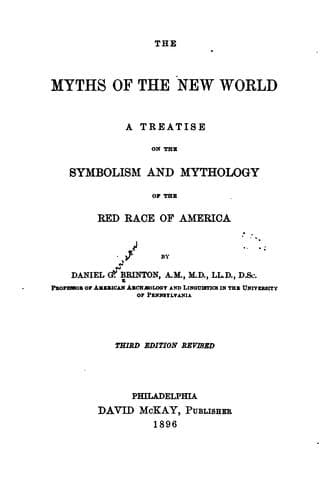
The Myths of the New World: A Treatise on the Symbolism and Mythology of the Red Race of America — John Shaqi
The Myths of the New World: A Treatise on the Symbolism and Mythology of the Red Race of AmericaBrinton, Daniel G. (Daniel Garrison)
Religion
The Myths of the New World: A Treatise on the Symbolism and Mythology of the Red Race of America
Brinton, Daniel G. (Daniel Garrison)
Indian mythology; Indians -- Folklore
[21-1] Gomara states that De Ayllon found tribes on the Atlantic shore
not far from Cape Hatteras keeping flocks of deer (_ciervos_) and from
their milk making cheese (_Hist. de las Indias_, cap. 43). I attach no
importance to this statement, and only mention it to connect it with some
other curious notices of the tribe now extinct who occupied that
locality. Both De Ayllon and Lawson mention their very light complexions,
and the latter saw many with blonde hair, blue eyes, and a fair skin;
they cultivated when first visited the potato (or the groundnut),
tobacco, and cotton (Humboldt); they reckoned time by disks of wood
divided into sixty segments (Lederer); and just in this latitude the most
careful determination fixes the mysterious White-man's-land, or Great
Ireland of the Icelandic Sagas (see the _American Hist. Mag._, ix. p.
364), where the Scandinavian sea rovers in the eleventh century found men
of their own color, clothed in long woven garments, and not less
civilized than themselves.
[23-1] The name Eskimo is from the Algonkin word _Eskimantick_, eaters of
raw flesh. There is reason to believe that at one time they possessed the
Atlantic coast considerably to the south. The Northmen, in the year 1000,
found the natives of Vinland, probably near Rhode Island, of the same
race as they were familiar with in Labrador. They call them _Skralingar_,
chips, and describe them as numerous and short of stature (Eric Rothens
Saga, in Mueller, _Sagænbibliothek_, p. 214). It is curious that the
traditions of the Tuscaroras, who placed their arrival on the Virginian
coast about 1300, spoke of the race they found there as eaters of raw
flesh and ignorant of maize (Lederer, _Account of North America_, in
Harris, Voyages).
[25-1] Richardson, _Arctic Expedition_, p. 374.
[25-2] The late Professor W. W. Turner of Washington, and Professor
Buschmann of Berlin, are the two scholars who have traced the boundaries
of this widely dispersed family. The name is drawn from Lake Athapasca in
British America.
[25-3] The Cherokee tongue has a limited number of words in common with
the Iroquois, and its structural similarity is close. The name is of
unknown origin. It should doubtless be spelled _Tsalakie_, a plural form,
almost the same as that of the river Tellico, properly Tsaliko (Ramsey,
_Annals of Tennessee_, p. 87), on the banks of which their principal
towns were situated. Adair's derivation from _cheera_, fire, is
worthless, as no such word exists in their language.
Public-domain text, read in full here on John Shaqi.
Reviews
Reviews
No reviews yet
Be the first to share your thoughts on this work.
Join the Discussion
Join the discussion
Sign in to leave a comment or review.
Sign InorCreate an account