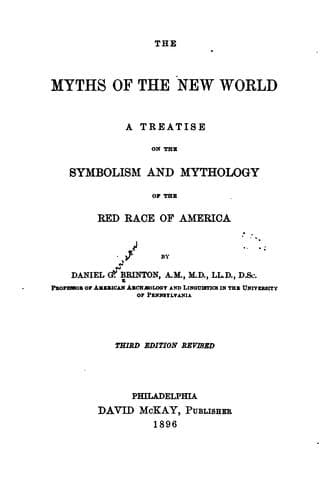
The Myths of the New World: A Treatise on the Symbolism and Mythology of the Red Race of AmericaBrinton, Daniel G. (Daniel Garrison)
Religion
The Myths of the New World: A Treatise on the Symbolism and Mythology of the Red Race of America
Brinton, Daniel G. (Daniel Garrison)
Indian mythology; Indians -- Folklore
Internal evidence proves that these legends were written down by a
converted native some time in the seventeenth century. They carry
the national history back about two centuries, beyond which all is
professedly mythical. Although both translations are colored by the
peculiar views of their makers, this is incomparably the most
complete and valuable work on American mythology extant.
Another authority of inestimable value has been placed within the
reach of scholars during the last few years. This is the _Relations
de la Nouvelle France_, containing the annual reports of the
Jesuit missionaries among the Iroquois and Algonkins from and
after 1611. My references to this are always to the reprint at
Quebec, 1858. Of not less excellence for another tribe, the Creeks,
is the brief "Sketch of the Creek Country," by Col. Benjamin
Hawkins, written about 1800, and first published in full by the
Georgia Historical Society in 1848. Most of the other works to
which I have referred are too well known to need any special
examination here, or will be more particularly mentioned in the
foot-notes when quoted.
FOOTNOTES:
[2-1] Waitz, _Anthropologie der Naturvoelker_, i. p. 256.
[2-2] Carriere, _Die Kunst im Zusammenhang der Culturentwickelung_, i. p.
66.
[6-1] It is said indeed that the Yebus, a people on the west coast of
Africa, speak a polysynthetic language, and _per contra_, that the Otomis
of Mexico have a monosyllabic one like the Chinese. Max Mueller goes
further, and asserts that what is called the process of agglutination in
the Turanian languages is the same as what has been named polysynthesis
in America. This is not to be conceded. In the former the root is
unchangeable, the formative elements follow it, and prefixes are not
used; in the latter prefixes are common, and the formative elements are
blended with the root, both undergoing changes of structure. Very
important differences.
[9-1] Grimm, _Geschichte der Deutschen Sprache_, p. 571.
[11-1] Peter Martyr, _De Insulis nuper Repertis_, p. 354: Colon. 1574.
[12-1] They may be found in Waitz, _Anthrop. der Naturvoelker_, iv. p.
173.
[13-1] The only authority is Diego de Landa, _Relacion de las Cosas de
Yucatan_, ed. Brasseur, Paris, 1864, p. 318. The explanation is extremely
obscure in the original. I have given it in the only sense in which the
author's words seem to have any meaning.
[14-1] Humboldt, _Vues des Cordillères_, p. 72.
[14-2] Desjardins, _Le Pérou avant la Conquête Espagnole_, p. 122: Paris,
1858.
[16-1] An instance is given by Ximenes, _Origen de los Indios de
Guatemala_, p. 186: Vienna, 1856.
[17-1] George Copway, _Traditional History of the Ojibway Nation_, p.
130: London, 1850.
[18-1] Morse, _Report on the Indian Tribes_, App. p. 352.
Public-domain text, read in full here on John Shaqi.
Reviews
Reviews
No reviews yet
Be the first to share your thoughts on this work.
Join the Discussion
Join the discussion
Sign in to leave a comment or review.
Sign InorCreate an account