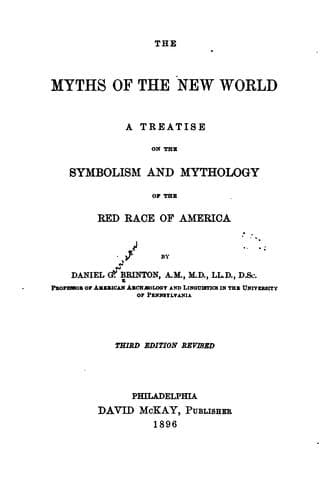
The Myths of the New World: A Treatise on the Symbolism and Mythology of the Red Race of America — John Shaqi
The Myths of the New World: A Treatise on the Symbolism and Mythology of the Red Race of AmericaBrinton, Daniel G. (Daniel Garrison)
Religion
The Myths of the New World: A Treatise on the Symbolism and Mythology of the Red Race of America
Brinton, Daniel G. (Daniel Garrison)
Indian mythology; Indians -- Folklore
If we accept the definition that mythology is the idea of God expressed
in symbol, figure, and narrative, and always struggling toward a clearer
utterance, it is well not only to trace this idea in its very earliest
embodiment in language, but also, for the sake of comparison, to ask
what is its latest and most approved expression. The reply to this is
given us by Immanuel Kant. He has shown that our reason, dwelling on the
facts of experience, constantly seeks the principles which connect them
together, and only rests satisfied in the conviction that there is a
highest and first principle which reconciles all their discrepancies and
binds them into one. This he calls the Ideal of Reason. It must be true,
for it is evolved from the laws of reason, our only test of truth.
Furthermore, the sense of personality and the voice of conscience,
analyzed to their sources, can only be explained by the assumption of an
infinite personality and an absolute standard of right. Or, if to some
all this appears but wire-drawn metaphysical subtlety, they are welcome
to the definition of the realist, that the idea of God is the sum of
those intelligent activities which the individual, reasoning from the
analogy of his own actions, imagines to be behind and to bring about
natural phenomena.[44-1] If either of these be correct, it were hard to
conceive how any tribe or even any sane man could be without some notion
of divinity.
Certainly in America no instance of its absence has been discovered.
Obscure, grotesque, unworthy it often was, but everywhere man was
oppressed with a _sensus numinis_, a feeling that invisible, powerful
agencies were at work around him, who, as they willed, could help or
hurt him. In every heart was an altar to the Unknown God. Not that it
was customary to attach any idea of unity to these unseen powers. The
supposition that in ancient times and in very unenlightened conditions,
before mythology had grown, a monotheism prevailed, which afterwards at
various times was revived by reformers, is a belief that should have
passed away when the delights of savage life and the praises of a state
of nature ceased to be the themes of philosophers. We are speaking of a
people little capable of abstraction. The exhibitions of force in nature
seemed to them the manifestations of that mysterious power felt by their
self-consciousness; to combine these various manifestations and
recognize them as the operations of one personality, was a step not
easily taken. Yet He is not far from every one of us. "Whenever man
thinks clearly, or feels deeply, he conceives God as self-conscious
unity," says Carriere, with admirable insight; and elsewhere, "we have
monotheism, not in contrast to polytheism, not clear to the thought, but
in living intuition in the religious sentiments."[45-1]
Public-domain text, read in full here on John Shaqi.
Reviews
Reviews
No reviews yet
Be the first to share your thoughts on this work.
Join the Discussion
Join the discussion
Sign in to leave a comment or review.
Sign InorCreate an account