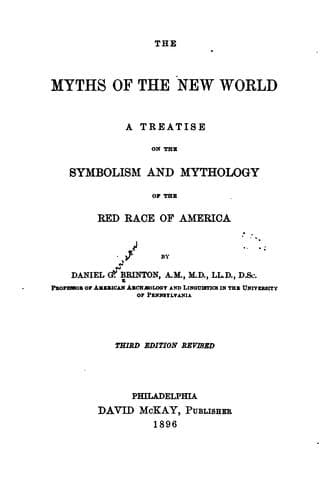
The Myths of the New World: A Treatise on the Symbolism and Mythology of the Red Race of America — John Shaqi
The Myths of the New World: A Treatise on the Symbolism and Mythology of the Red Race of AmericaBrinton, Daniel G. (Daniel Garrison)
Religion
The Myths of the New World: A Treatise on the Symbolism and Mythology of the Red Race of America
Brinton, Daniel G. (Daniel Garrison)
Indian mythology; Indians -- Folklore
Thus it was among the Indians. Therefore a word is usually found in
their languages analogous to none in any European tongue, a word
comprehending all manifestations of the unseen world, yet conveying no
sense of personal unity. It has been rendered spirit, demon, God, devil,
mystery, magic, but commonly and rather absurdly by the English and
French, "medicine." In the Algonkin dialects this word is _manito_ and
_oki_, in Iroquois _oki_ and _otkon_, the Dakota has _wakan_, the Aztec
_teotl_, the Quichua _huaca_, and the Maya _ku_. They all express in its
most general form the idea of the supernatural. And as in this word,
supernatural, we see a transfer of a conception of place, and that it
literally means that which is _above_ the natural world, so in such as
we can analyze of these vague and primitive terms the same trope appears
discoverable. _Wakan_ as an adverb means _above_, _oki_ is but another
orthography for _oghee_, and _otkon_ seems allied to _hetken_, both of
which have the same signification.[46-1]
The transfer is no mere figure of speech, but has its origin in the very
texture of the human mind. The heavens, the upper regions, are in every
religion the supposed abode of the divine. What is higher is always the
stronger and the nobler; a _superior_ is one who is better than we are,
and therefore a chieftain in Algonkin is called _oghee-ma_, the higher
one. There is, moreover, a naif and spontaneous instinct which leads man
in his ecstasies of joy, and in his paroxysms of fear or pain, to lift
his hands and eyes to the overhanging firmament. There the sun and
bright stars sojourn, emblems of glory and stability. Its azure vault
has a mysterious attraction which invites the eye to gaze longer and
longer into its infinite depths.[46-2] Its color brings thoughts of
serenity, peace, sunshine, and warmth. Even the rudest hunting tribes
felt these sentiments, and as a metaphor in their speeches, and as a
paint expressive of friendly design, blue was in wide use among
them.[47-1]
So it came to pass that the idea of God was linked to the heavens long
ere man asked himself, are the heavens material and God spiritual, is He
one, or is He many? Numerous languages bear trace of this. The Latin
Deus, the Greek Zeus, the Sanscrit Dyaus, the Chinese Tien, all
originally meant the sky above, and our own word heaven is often
employed synonymously with God. There is at first no personification in
these expressions. They embrace all unseen agencies, they are void of
personality, and yet to the illogical primitive man there is nothing
contradictory in making them the object of his prayers. The Mayas had
legions of gods; "_ku_," says their historian,[47-2] "does not signify
any particular god; yet their prayers are sometimes addressed to _kue_,"
which is the same word in the vocative case.
Public-domain text, read in full here on John Shaqi.
Reviews
Reviews
No reviews yet
Be the first to share your thoughts on this work.
Join the Discussion
Join the discussion
Sign in to leave a comment or review.
Sign InorCreate an account