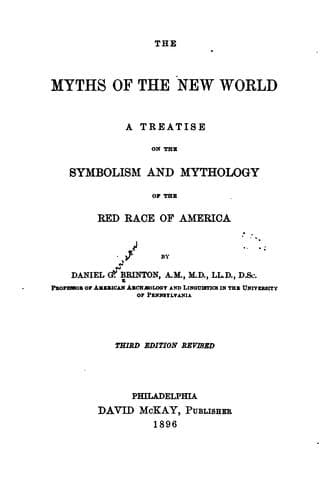
The Myths of the New World: A Treatise on the Symbolism and Mythology of the Red Race of AmericaBrinton, Daniel G. (Daniel Garrison)
Religion
The Myths of the New World: A Treatise on the Symbolism and Mythology of the Red Race of America
Brinton, Daniel G. (Daniel Garrison)
Indian mythology; Indians -- Folklore
This view, which has obtained without question in every work on the
native religions of America, has arisen partly from habits of thought
difficult to break, partly from mistranslations of native words, partly
from the foolish axiom of the early missionaries, "The gods of the
gentiles are devils." Yet their own writings furnish conclusive proof
that no such distinction existed out of their own fancies. The same word
(_otkon_) which Father Bruyas employs to translate into Iroquois the
term "devil," in the passage "the Devil took upon himself the figure of
a serpent," he is obliged to use for "spirit" in the phrase, "at the
resurrection we shall be spirits,"[59-2] which is a rather amusing
illustration how impossible it was by any native word to convey the idea
of the spirit of evil. When, in 1570, Father Rogel commenced his labors
among the tribes near the Savannah River, he told them that the deity
they adored was a demon who loved all evil things, and they must hate
him; whereupon his auditors replied, that so far from this being the
case, whom he called a wicked being was the power that sent them all
good things, and indignantly left the missionary to preach to the
winds.[60-1]
A passage often quoted in support of this mistaken view is one in
Winslow's "Good News from New England," written in 1622. The author says
that the Indians worship a good power called Kiehtan, and another "who,
as farre as wee can conceive, is the Devill," named Hobbamock, or
Hobbamoqui. The former of these names is merely the word "great," in
their dialect of Algonkin, with a final _n_, and is probably an
abbreviation of Kittanitowit, the great manito, a vague term mentioned
by Roger Williams and other early writers, not the appellation of any
personified deity.[60-2] The latter, so far from corresponding to the
power of evil, was, according to Winslow's own statement, the kindly god
who cured diseases, aided them in the chase, and appeared to them in
dreams as their protector. Therefore, with great justice, Dr. Jarvis has
explained it to mean "the _oke_ or tutelary deity which each Indian
worships," as the word itself signifies.[61-1]
Public-domain text, read in full here on John Shaqi.
Reviews
Reviews
No reviews yet
Be the first to share your thoughts on this work.
Join the Discussion
Join the discussion
Sign in to leave a comment or review.
Sign InorCreate an account