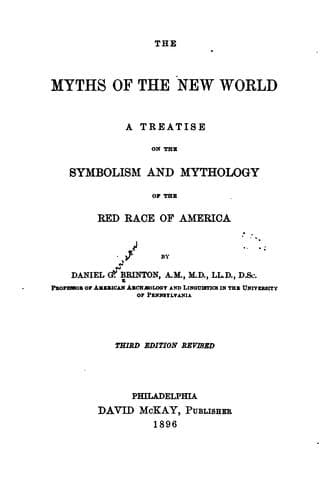
The Myths of the New World: A Treatise on the Symbolism and Mythology of the Red Race of AmericaBrinton, Daniel G. (Daniel Garrison)
Religion
The Myths of the New World: A Treatise on the Symbolism and Mythology of the Red Race of America
Brinton, Daniel G. (Daniel Garrison)
Indian mythology; Indians -- Folklore
In neither case, be it observed, was any attempt made to substitute
another and purer religion for the popular one. The Inca continued to
receive the homage of his subjects as a brother of the sun, and the
regular services to that luminary were never interrupted. Nor did the
prince of Tezcuco afterwards neglect the honors due his national gods,
nor even refrain himself from plunging the knife into the breasts of
captives on the altar of the god of war.[57-2] They were but expressions
of that monotheism which is ever present, "not in contrast to
polytheism, but in living intuition in the religious sentiments." If
this subtle but true distinction be rightly understood, it will excite
no surprise to find such epithets as "endless," "omnipotent,"
"invisible," "adorable," such appellations as "the Maker and Moulder of
All," "the Mother and Father of Life," "the One God complete in
perfection and unity," "the Creator of all that is," "the Soul of the
World," in use and of undoubted indigenous origin not only among the
civilized Aztecs, but even among the Haitians, the Araucanians, the
Lenni Lenape, and others.[57-3] It will not seem contradictory to hear
of them in a purely polytheistic worship; we shall be far from
regarding them as familiar to the popular mind, and we shall never be
led so far astray as to adduce them in evidence of a monotheism in
either technical sense of that word. In point of fact they were not
applied to any particular god even in the most enlightened nations, but
were terms of laudation and magniloquence used by the priests and
devotees of every several god to do him honor. They prove something in
regard to a consciousness of divinity hedging us about, but nothing at
all in favor of a recognition of one God; they exemplify how profound is
the conviction of a highest and first principle, but they do not offer
the least reason to surmise that this was a living reality in doctrine
or practice.
The confusion of these distinct ideas has led to much misconception of
the native creeds. But another and more fatal error was that which
distorted them into a dualistic form, ranging on one hand the good
spirit with his legions of angels, on the other the evil one with his
swarms of fiends, representing the world as the scene of their unending
conflict, man as the unlucky football who gets all the blows. This
notion, which has its historical origin among the Parsees of ancient
Iran, is unknown to savage nations. "The idea of the Devil," justly
observes Jacob Grimm, "is foreign to all primitive religions." Yet
Professor Mueller, in his voluminous work on those of America, after
approvingly quoting this saying, complacently proceeds to classify the
deities as good or bad spirits![59-1]
Public-domain text, read in full here on John Shaqi.
Reviews
Reviews
No reviews yet
Be the first to share your thoughts on this work.
Join the Discussion
Join the discussion
Sign in to leave a comment or review.
Sign InorCreate an account