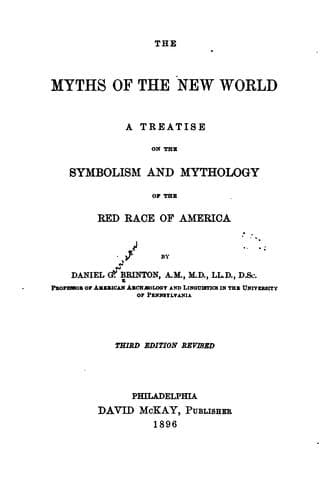
The Myths of the New World: A Treatise on the Symbolism and Mythology of the Red Race of America — John Shaqi
The Myths of the New World: A Treatise on the Symbolism and Mythology of the Red Race of AmericaBrinton, Daniel G. (Daniel Garrison)
Religion
The Myths of the New World: A Treatise on the Symbolism and Mythology of the Red Race of America
Brinton, Daniel G. (Daniel Garrison)
Indian mythology; Indians -- Folklore
Perhaps no myth has been so often quoted in its confirmation as that of
the ancient Iroquois, which narrates the conflict between the first two
brothers of our race. It is of undoubted native origin and venerable
antiquity. The version given by the Tuscarora chief Cusic in 1825,
relates that in the beginning of things there were two brothers,
Enigorio and Enigohahetgea, names literally meaning the Good Mind and
the Bad Mind.[63-1] The former went about the world furnishing it with
gentle streams, fertile plains, and plenteous fruits, while the latter
maliciously followed him creating rapids, thorns, and deserts. At length
the Good Mind turned upon his brother in anger, and crushed him into the
earth. He sank out of sight in its depths, but not to perish, for in the
dark realms of the underworld he still lives, receiving the souls of the
dead and being the author of all evil. Now when we compare this with the
version of the same legend given by Father Brebeuf, missionary to the
Hurons in 1636, we find its whole complexion altered; the moral dualism
vanishes; the names Good Mind and Bad Mind do not appear; it is the
struggle of Ioskeha, the White one, with his brother Tawiscara, the Dark
one, and we at once perceive that Christian influence in the course of
two centuries had given the tale a meaning foreign to its original
intent.
So it is with the story the Algonkins tell of their hero Manibozho, who,
in the opinion of a well-known writer, "is always placed in antagonism
to a great serpent, a spirit of evil."[64-1] It is to the effect that
after conquering many animals, this famous magician tried his arts on
the prince of serpents. After a prolonged struggle, which brought on the
general deluge and the destruction of the world, he won the victory. The
first authority we have for this narrative is even later than Cusic; it
is Mr. Schoolcraft in our own day; the legendary cause of the deluge as
related by Father Le Jeune, in 1634, is quite dissimilar, and makes no
mention of a serpent; and as we shall hereafter see, neither among the
Algonkins nor any other Indians, was the serpent usually a type of evil,
but quite the reverse.[64-2]
Public-domain text, read in full here on John Shaqi.
Reviews
Reviews
No reviews yet
Be the first to share your thoughts on this work.
Join the Discussion
Join the discussion
Sign in to leave a comment or review.
Sign InorCreate an account