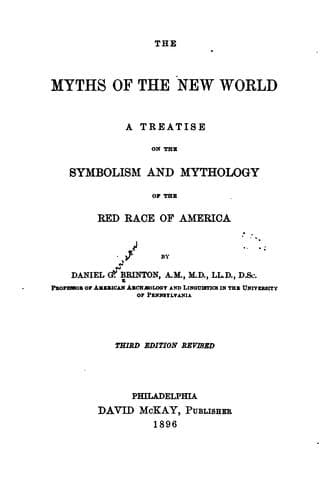
The Myths of the New World: A Treatise on the Symbolism and Mythology of the Red Race of AmericaBrinton, Daniel G. (Daniel Garrison)
Religion
The Myths of the New World: A Treatise on the Symbolism and Mythology of the Red Race of America
Brinton, Daniel G. (Daniel Garrison)
Indian mythology; Indians -- Folklore
The comparatively late introduction of such views into the native
legends finds a remarkable proof in the myths of the Quiches, which were
committed to writing in the seventeenth century. They narrate the
struggles between the rulers of the upper and the nether world, the
descent of the former into Xibalba, the Realm of Phantoms, and their
victory over its lords, One Death and Seven Deaths. The writer adds of
the latter, who clearly represent to his mind the Evil One and his
adjutants, "in the old times they did not have much power; they were but
annoyers and opposers of men, and in truth they were not regarded as
gods. But when they appeared it was terrible. They were of evil, they
were owls, fomenting trouble and discord." In this passage, which, be it
said, seems to have impressed the translators very differently, the
writer appears to compare the great power assigned by the Christian
religion to Satan and his allies, with the very much less potency
attributed to their analogues in heathendom, the rulers of the world of
the dead.[65-1]
A little reflection will convince the most incredulous that any such
dualism as has been fancied to exist in the native religions, could not
have been of indigenous growth. The gods of the primitive man are beings
of thoroughly human physiognomy, painted with colors furnished by
intercourse with his fellows. These are his enemies or his friends, as
he conciliates or insults them. No mere man, least of all a savage, is
kind and benevolent in spite of neglect and injury, nor is any man
causelessly and ceaselessly malicious. Personal, family, or national
feuds render some more inimical than others, but always from a desire to
guard their own interests, never out of a delight in evil for its own
sake. Thus the cruel gods of death, disease, and danger, were never of
Satanic nature, while the kindliest divinities were disposed to punish,
and that severely, any neglect of their ceremonies. Moral dualism can
only arise in minds where the ideas of good and evil are not synonymous
with those of pleasure and pain, for the conception of a wholly good or
a wholly evil nature requires the use of these terms in their higher,
ethical sense. The various deities of the Indians, it may safely be said
in conclusion, present no stronger antithesis in this respect than those
of ancient Greece and Rome.
FOOTNOTES:
Public-domain text, read in full here on John Shaqi.
Reviews
Reviews
No reviews yet
Be the first to share your thoughts on this work.
Join the Discussion
Join the discussion
Sign in to leave a comment or review.
Sign InorCreate an account