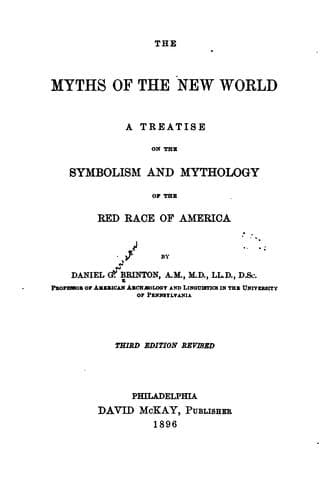
The Myths of the New World: A Treatise on the Symbolism and Mythology of the Red Race of AmericaBrinton, Daniel G. (Daniel Garrison)
Religion
The Myths of the New World: A Treatise on the Symbolism and Mythology of the Red Race of America
Brinton, Daniel G. (Daniel Garrison)
Indian mythology; Indians -- Folklore
Here was an orator advocating the unity of the human species, affirming
that the chief end of man is to develop an innate idea of God, and that
all religions, except the one he preached, were examples of more or
less unsuccessful attempts to do so. No wonder the Athenians, who
acknowledged no kinship to barbarians, who looked dubiously at the
doctrine of innate ideas, and were divided in opinion as to whether
their mythology was a shrewd device of legislators to keep the populace
in subjection, a veiled natural philosophy, or the celestial reflex of
their own history, mocked at such a babbler and went their ways. The
generations of philosophers that followed them partook of their doubts
and approved their opinions, quite down to our own times. But now, after
weighing the question maturely, we are compelled to admit that the
Apostle was not so wide of the mark after all--that, in fact, the latest
and best authorities, with no bias in his favor, support his position
and may almost be said to paraphrase his words. For according to a
writer who ranks second to none in the science of ethnology, the
severest and most recent investigations show that "not only do
acknowledged facts permit the assumption of the unity of the human
species, but this opinion is attended with fewer discrepancies, and has
greater inner consistency than the opposite one of specific
diversity."[2-1] And as to the religions of heathendom, the view of
Saint Paul is but expressed with a more poetic turn by a distinguished
living author when he calls them "not fables, but truths, though clothed
in a garb woven by fancy, wherein the web is the notion of God, the
ideal of reason in the soul of man, the thought of the Infinite."[2-2]
Inspiration and science unite therefore to bid us dismiss the effete
prejudice that natural religions either arise as the ancient
philosophies taught, or that they are, as the Dark Ages imagined, subtle
nets of the devil spread to catch human souls. They are rather the
unaided attempts of man to find out God; they are the efforts of the
reason struggling to define the infinite; they are the expressions of
that "yearning after the gods" which the earliest of poets discerned in
the hearts of all men. Studied in this sense they are rich in teachings.
Would we estimate the intellectual and æsthetic culture of a people,
would we generalize the laws of progress, would we appreciate the
sublimity of Christianity, and read the seals of its authenticity: the
natural conceptions of divinity reveal them. No mythologies are so
crude, therefore, none so barbarous, but deserve the attention of the
philosophic mind, for they are never the empty fictions of an idle
fancy, but rather the utterances, however inarticulate, of an immortal
and ubiquitous intuition.
Public-domain text, read in full here on John Shaqi.
Reviews
Reviews
No reviews yet
Be the first to share your thoughts on this work.
Join the Discussion
Join the discussion
Sign in to leave a comment or review.
Sign InorCreate an account