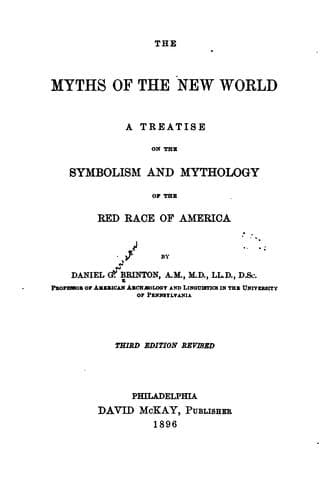
The Myths of the New World: A Treatise on the Symbolism and Mythology of the Red Race of AmericaBrinton, Daniel G. (Daniel Garrison)
Religion
The Myths of the New World: A Treatise on the Symbolism and Mythology of the Red Race of America
Brinton, Daniel G. (Daniel Garrison)
Indian mythology; Indians -- Folklore
These considerations embolden me to approach with some confidence even
the aboriginal religions of America, so often stigmatized as incoherent
fetichisms, so barren, it has been said, in grand or beautiful
creations. The task bristles with difficulties. Carelessness,
prepossessions, and ignorance have disfigured them with false colors and
foreign additions without number. The first maxim, therefore, must be to
sift and scrutinize authorities, and to reject whatever betrays the
plastic hand of the European. For the religions developed by the red
race, not those mixed creeds learned from foreign invaders, are to be
the subjects of our study. Then will remain the formidable undertaking
of reducing the authentic materials thus obtained to system and order,
and this not by any preconceived theory of what they ought to conform
to, but learning from them the very laws of religious growth they
illustrate. The historian traces the birth of arts, science, and
government to man's dependence on nature and his fellows for the means
of self-preservation. Not that man receives these endowments from
without, but that the stern step-mother, Nature, forces him by threats
and stripes to develop his own inherent faculties. So with religion: The
idea of God does not, and cannot, proceed from the external world, but,
nevertheless, it finds its _historical_ origin also in the desperate
struggle for life, in the satisfaction of the animal wants and passions,
in those vulgar aims and motives which possessed the mind of the
primitive man to the exclusion of everything else.
There is an ever present embarrassment in such inquiries. In dealing
with these matters beyond the cognizance of the senses, the mind is
forced to express its meaning in terms transferred from sensuous
perceptions, or under symbols borrowed from the material world. These
transfers must be understood, these symbols explained, before the real
meaning of a myth can be reached. He who fails to guess the riddle of
the sphynx, need not hope to gain admittance to the shrine. With
delicate ear the faint whispers of thought must be apprehended which
prompt the intellect when it names the immaterial from the material;
when it chooses from the infinity of visible forms those meet to shadow
forth Divinity.
Public-domain text, read in full here on John Shaqi.
Reviews
Reviews
No reviews yet
Be the first to share your thoughts on this work.
Join the Discussion
Join the discussion
Sign in to leave a comment or review.
Sign InorCreate an account