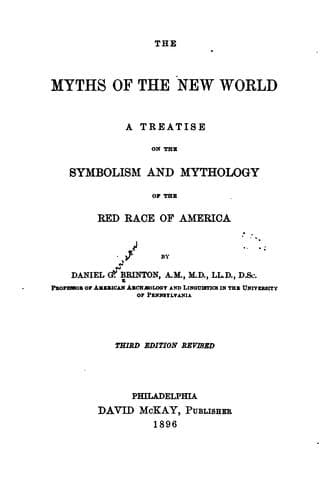
The Myths of the New World: A Treatise on the Symbolism and Mythology of the Red Race of AmericaBrinton, Daniel G. (Daniel Garrison)
Religion
The Myths of the New World: A Treatise on the Symbolism and Mythology of the Red Race of America
Brinton, Daniel G. (Daniel Garrison)
Indian mythology; Indians -- Folklore
The assumption of precisely four cardinal points is not of chance; it is
recognized in every language; it is rendered essential by the anatomical
structure of the body; it is derived from the immutable laws of the
universe. Whether we gaze at the sunset or the sunrise, or whether at
night we look for guidance to the only star of the twinkling thousands
that is constant to its place, the anterior and posterior planes of our
bodies, our right hands and our left coincide with the parallels and
meridians. Very early in his history did man take note of these four
points, and recognizing in them his guides through the night and the
wilderness, call them his gods. Long afterwards, when centuries of slow
progress had taught him other secrets of nature--when he had discerned
in the motions of the sun, the elements of matter, and the radicals of
arithmetic a repetition of this number--they were to him further
warrants of its sacredness. He adopted it as a regulating quantity in
his institutions and his arts; he repeated it in its multiples and
compounds; he imagined for it novel applications; he constantly
magnified its mystic meaning; and finally, in his philosophical
reveries, he called it the key to the secrets of the universe, "the
source of ever-flowing nature."[68-1]
In primitive geography the figure of the earth is a square plain; in the
legend of the Quiché's it is "shaped as a square, divided into four
parts, marked with lines, measured with cords, and suspended from the
heavens by a cord to its four corners and its four sides."[68-2] The
earliest divisions of territory were in conformity to this view. Thus it
was with ancient Egypt, Syria, Mesopotamia, and China;[68-3] and in the
new world, the states of Peru, Araucania, the Muyscas, the Quichés, and
Tlascala were tetrarchies divided in accordance with, and in the first
two instances named after, the cardinal points. So their chief
cities--Cuzco, Quito, Tezcuco, Mexico, Cholula--were quartered by
streets running north, south, east, and west. It was a necessary result
of such a division that the chief officers of the government were four
in number, that the inhabitants of town and country, that the whole
social organization acquired a quadruplicate form. The official title of
the Incas was "Lord of the four quarters of the earth," and the
venerable formality in taking possession of land, both in their domain
and that of the Aztecs, was to throw a stone, to shoot an arrow, or to
hurl a firebrand to each of the cardinal points.[69-1] They carried out
the idea in their architecture, building their palaces in squares with
doors opening, their tombs with their angles pointing, their great
causeways running in these directions. These architectural principles
repeat themselves all over the continent; they recur in the sacred
structures of Yucatan, in the ancient cemetery of Teo-tihuacan near
Mexico, where the tombs are arranged along avenues corresponding exactly
Public-domain text, read in full here on John Shaqi.
Reviews
Reviews
No reviews yet
Be the first to share your thoughts on this work.
Join the Discussion
Join the discussion
Sign in to leave a comment or review.
Sign InorCreate an account