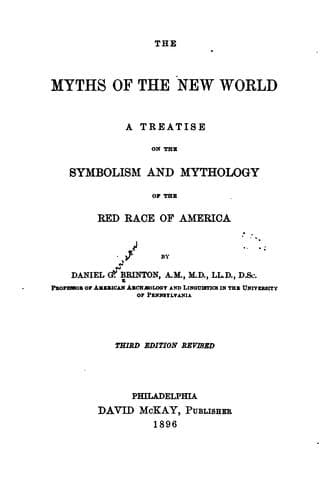
The Myths of the New World: A Treatise on the Symbolism and Mythology of the Red Race of AmericaBrinton, Daniel G. (Daniel Garrison)
Religion
The Myths of the New World: A Treatise on the Symbolism and Mythology of the Red Race of America
Brinton, Daniel G. (Daniel Garrison)
Indian mythology; Indians -- Folklore
[64-2] Both these legends will be analyzed in a subsequent chapter, and
an attempt made not only to restore them their primitive form, but to
explain their meaning.
[65-1] Compare the translation and remarks of Ximenes, _Or. de los Indios
de Guat._, p. 76, with those of Brasseur, _Le Livre Sacré des Quichés_,
p. 189.
CHAPTER III.
THE SACRED NUMBER, ITS ORIGIN AND APPLICATIONS.
The number FOUR sacred in all American religions, and the key to
their symbolism.--Derived from the CARDINAL POINTS.--Appears
constantly in government, arts, rites, and myths.--The Cardinal
Points identified with the Four Winds, who in myths are the four
ancestors of the human race, and the four celestial rivers watering
the terrestrial Paradise.--Associations grouped around each
Cardinal Point.--From the number four was derived the symbolic
value of the number _Forty_, and the _Sign of the Cross_.
Every one familiar with the ancient religions of the world must have
noticed the mystic power they attach to certain numbers, and how these
numbers became the measures and formative quantities, as it were, of
traditions and ceremonies, and had a symbolical meaning nowise connected
with their arithmetical value. For instance, in many eastern religions,
that of the Jews among the rest, _seven_ was the most sacred number, and
after it, _four_ and _three_. The most cursory reader must have observed
in how many connections the seven is used in the Hebrew Scriptures,
occurring, in all, something over three hundred and sixty times, it is
said. Why these numbers were chosen rather than others has not been
clearly explained. Their sacred character dates beyond the earliest
history, and must have been coeval with the first expressions of the
religious sentiment. Only one of them, the FOUR, has any prominence in
the religions of the red race, but this is so marked and so universal,
that at a very early period in my studies I felt convinced that if the
reason for its adoption could be discovered, much of the apparent
confusion which reigns among them would be dispelled.
Such a reason must take its rise from some essential relation of man to
nature, everywhere prominent, everywhere the same. It is found in the
_adoration of the cardinal points_.
The red man, as I have said, was a hunter; he was ever wandering through
pathless forests, coursing over boundless prairies. It seems to the
white race not a faculty, but an instinct that guides him so unerringly.
He is never at a loss. Says a writer who has deeply studied his
character: "The Indian ever has the points of the compass present to his
mind, and expresses himself accordingly in words, although it shall be
of matters in his own house."[67-1]
Public-domain text, read in full here on John Shaqi.
Reviews
Reviews
No reviews yet
Be the first to share your thoughts on this work.
Join the Discussion
Join the discussion
Sign in to leave a comment or review.
Sign InorCreate an account