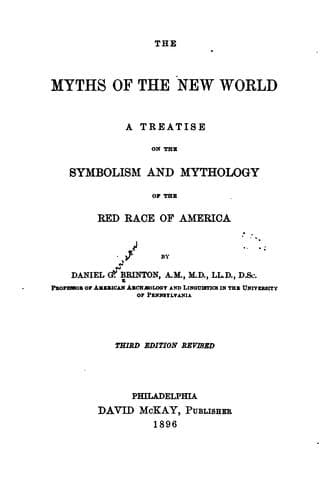
The Myths of the New World: A Treatise on the Symbolism and Mythology of the Red Race of AmericaBrinton, Daniel G. (Daniel Garrison)
Religion
The Myths of the New World: A Treatise on the Symbolism and Mythology of the Red Race of America
Brinton, Daniel G. (Daniel Garrison)
Indian mythology; Indians -- Folklore
Proximity of place had no part in this similarity of rite. In the grand
commemorative festival of the Creeks called the Busk, which wiped out
the memory of all crimes but murder, which reconciled the proscribed
criminal to his nation and atoned for his guilt, when the new fire was
kindled and the green corn served up, every dance, every invocation,
every ceremony, was shaped and ruled by the application of the number
four and its multiples in every imaginable relation. So it was at that
solemn probation which the youth must undergo to prove himself worthy of
the dignities of manhood and to ascertain his guardian spirit; here
again his fasts, his seclusions, his trials, were all laid down in
fourfold arrangement.[72-1]
Not alone among these barbarous tribes were the cardinal points thus the
foundation of the most solemn mysteries of religion. An excellent
authority relates that the Aztecs of Micla, in Guatemala, celebrated
their chief festival four times a year, and that four priests solemnized
its rites. They commenced by invoking and offering incense to the sky
and the four cardinal points; they conducted the human victim four times
around the temple, then tore out his heart, and catching the blood in
four vases scattered it in the same directions.[72-2] So also the
Peruvians had four principal festivals annually, and at every new moon
one of four days' duration. In fact the repetition of the number in all
their religious ceremonies is so prominent that it has been a subject of
comment by historians. They have attributed it to the knowledge of the
solstices and equinoxes, but assuredly it is of more ancient date than
this. The same explanation has been offered for its recurrence among the
Nahuas of Mexico, whose whole lives were subjected to its operation. At
birth the mother was held unclean for four days, a fire was kindled and
kept burning for a like length of time, at the baptism of the child an
arrow was shot to each of the cardinal points. Their prayers were
offered four times a day, the greatest festivals were every fourth year,
and their offerings of blood were to the four points of the compass. At
death food was placed on the grave, as among the Eskimos, Creeks, and
Algonkins, for four days (for all these nations supposed that the
journey to the land of souls was accomplished in that time), and
mourning for the dead was for four months or four years.[73-1]
It were fatiguing and unnecessary to extend the catalogue much further.
Yet it is not nearly exhausted. From tribes of both continents and all
stages of culture, the Muyscas of Columbia and the Natchez of Louisiana,
the Quichés of Guatemala and the Caribs of the Orinoko, instance after
instance might be marshalled to illustrate how universally a sacred
character was attached to this number, and how uniformly it is traceable
to a veneration of the cardinal points. It is sufficient that it be
displayed in some of its more unusual applications.
Public-domain text, read in full here on John Shaqi.
Reviews
Reviews
No reviews yet
Be the first to share your thoughts on this work.
Join the Discussion
Join the discussion
Sign in to leave a comment or review.
Sign InorCreate an account