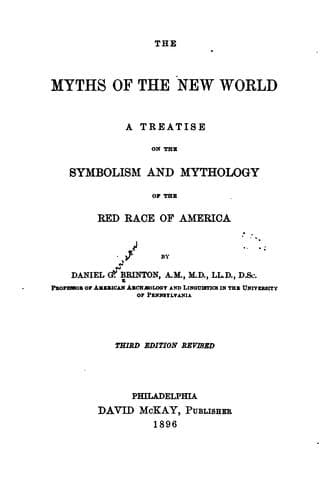
The Myths of the New World: A Treatise on the Symbolism and Mythology of the Red Race of America — John Shaqi
The Myths of the New World: A Treatise on the Symbolism and Mythology of the Red Race of AmericaBrinton, Daniel G. (Daniel Garrison)
Religion
The Myths of the New World: A Treatise on the Symbolism and Mythology of the Red Race of America
Brinton, Daniel G. (Daniel Garrison)
Indian mythology; Indians -- Folklore
It is well known that the calendar common to the Aztecs and Mayas
divides the month into four weeks, each containing a like number of
secular days; that their indiction is divided into four periods; and
that they believed the world had passed through four cycles. It has not
been sufficiently emphasized that in many of the picture writings these
days of the week are placed respectively north, south, east, and west,
and that in the Maya language the quarters of the indiction still bear
the names of the cardinal points, hinting the reason of their
adoption.[74-1] This cannot be fortuitous. Again, the division of the
year into four seasons--a division as devoid of foundation in nature as
that of the ancient Aryans into three, and unknown among many tribes,
yet obtained in very early times among Algonkins, Cherokees, Choctaws,
Creeks, Aztecs, Muyscas, Peruvians, and Araucanians. They were supposed
to be produced by the unending struggles and varying fortunes of the
four aerial giants who rule the winds.
We must seek in mythology the key to the monotonous repetition and the
sanctity of this number; and furthermore, we must seek it in those
natural modes of expression of the religious sentiment which are above
the power of blood or circumstance to control. One of these modes, we
have seen, was that which led to the identification of the divinity with
the wind, and this it is that solves the enigma in the present instance.
Universally the spirits of the cardinal points were imagined to be in
the winds that blew from them. The names of these directions and of the
corresponding winds are often the same, and when not, there exists an
intimate connection between them. For example, take the languages of the
Mayas, Huastecas, and Moscos of Central America; in all of them the word
for _north_ is synonymous with _north wind_, and so on for the other
three points of the compass. Or again, that of the Dakotas, and the word
_tate-ouye-toba_, translated "the four quarters of the heavens," means
literally, "whence the four winds come."[75-1] It were not difficult to
extend the list; but illustrations are all that is required. Let it be
remembered how closely the motions of the air are associated in thought
and language with the operations of the soul and the idea of God; let it
further be considered what support this association receives from the
power of the winds on the weather, bringing as they do the lightning and
the storm, the zephyr that cools the brow, and the tornado that levels
the forest; how they summon the rain to fertilize the seed and refresh
the shrivelled leaves; how they aid the hunter to stalk the game, and
usher in the varying seasons; how, indeed, in a hundred ways, they
intimately concern his comfort and his life; and it will not seem
strange that they almost occupied the place of all other gods in the
mind of the child of nature. Especially as those who gave or withheld
the rains were they objects of his anxious solicitation. "Ye who dwell
Public-domain text, read in full here on John Shaqi.
Reviews
Reviews
No reviews yet
Be the first to share your thoughts on this work.
Join the Discussion
Join the discussion
Sign in to leave a comment or review.
Sign InorCreate an account