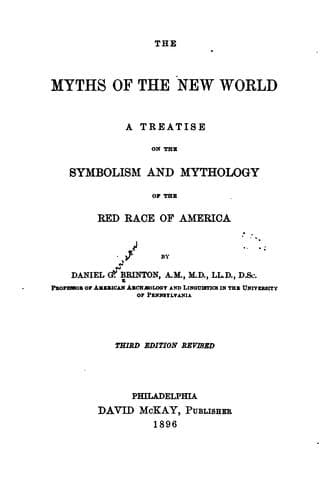
The Myths of the New World: A Treatise on the Symbolism and Mythology of the Red Race of AmericaBrinton, Daniel G. (Daniel Garrison)
Religion
The Myths of the New World: A Treatise on the Symbolism and Mythology of the Red Race of America
Brinton, Daniel G. (Daniel Garrison)
Indian mythology; Indians -- Folklore
Go where we will, the same story meets us. The empire of the Incas was
attributed in the sacred chants of the Amautas, the priests assigned to
take charge of the records, to four brothers and their wives. These
mythical civilizers are said to have emerged from a cave called _Pacari
tampu_, which may mean "the House of Subsistence," reminding us of the
four heroes who in Aztec legend set forth to people the world from
Tonacatepec, the mountain of our subsistence; or again it may mean--for
like many of these mythical names it seems to have been designedly
chosen to bear a double construction--the Lodgings of the Dawn,
recalling another Aztec legend which points for the birthplace of the
race to Tula in the distant orient. The cave itself suggests to the
classical reader that of Eolus, or may be paralleled with that in which
the Iroquois fabled the winds were imprisoned by their lord.[83-1] These
brothers were of no common kin. Their voices could shake the earth and
their hands heap up mountains. Like the thunder god, they stood on the
hills and hurled their sling-stones to the four corners of the earth.
When one was overpowered he fled upward to the heaven or was turned into
stone, and it was by their aid and counsel that the savages who
possessed the land renounced their barbarous habits and commenced to
till the soil. There can be no doubt but that this in turn is but
another transformation of the Protean myth we have so long
pursued.[83-2]
There are traces of the same legend among many other tribes of the
continent, but the trustworthy reports we have of them are too scanty to
permit analysis. Enough that they are mentioned in a note, for it is
every way likely that could we resolve their meaning they too would
carry us back to the four winds.[83-3]
Public-domain text, read in full here on John Shaqi.
Reviews
Reviews
No reviews yet
Be the first to share your thoughts on this work.
Join the Discussion
Join the discussion
Sign in to leave a comment or review.
Sign InorCreate an account