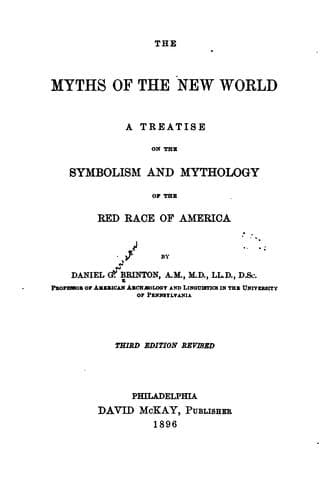
The Myths of the New World: A Treatise on the Symbolism and Mythology of the Red Race of AmericaBrinton, Daniel G. (Daniel Garrison)
Religion
The Myths of the New World: A Treatise on the Symbolism and Mythology of the Red Race of America
Brinton, Daniel G. (Daniel Garrison)
Indian mythology; Indians -- Folklore
Let no one suppose, however, that this was the only myth of the origin
of man. Far from it. It was but one of many, for, as I shall hereafter
attempt to show, the laws that governed the formations of such myths not
only allowed but enjoined great divergence of form. Equally far was it
from being the only image which the inventive fancy hit upon to express
the action of the winds as the rain bringers. They too were many, but
may all be included in a twofold division, either as the winds were
supposed to flow in from the corners of the earth or outward from its
central point. Thus they are spoken of under such figures as four
tortoises at the angles of the earthly plane who vomit forth the
rains,[85-1] or four gigantic caryatides who sustain the heavens and
blow the winds from their capacious lungs,[85-2] or more frequently as
four rivers flowing from the broken calabash on high, as the Haitians,
draining the waters of the primitive world,[85-3] as four animals who
bring from heaven the maize,[85-4] as four messengers whom the god of
air sends forth, or under a coarser trope as the spittle he ejects
toward the cardinal points which is straightway transformed into wild
rice, tobacco, and maize.[85-5]
Constantly from the palace of the lord of the world, seated on the high
hill of heaven, blow four winds, pour four streams, refreshing and
fecundating the earth. Therefore, in the myths of ancient Iran there is
mention of a celestial fountain, Arduisur, the virgin daughter of
Ormuzd, whence four all nourishing rivers roll their waves toward the
cardinal points; therefore the Thibetans believe that on the sacred
mountain Himavata grows the tree of life Zampu, from whose foot once
more flow the waters of life in four streams to the four quarters of the
world; and therefore it is that the same tale is told by the Chinese of
the mountain Kouantun, by the Brahmins of Mount Meru, and by the Parsees
of Mount Albors in the Caucasus.[85-6] Each nation called their sacred
mountain "the navel of the earth;" for not only was it the supposed
centre of the habitable world, but through it, as the fœtus through
the umbilical cord, the earth drew her increase. Beyond all other spots
were they accounted fertile, scenes of joyous plaisance, of repose, and
eternal youth; there rippled the waters of health, there blossomed the
tree of life; they were fit trysting spots of gods and men. Hence came
the tales of the terrestrial paradise, the rose garden of Feridun, the
Eden gardens of the world. The name shows the origin, for paradise (in
Sanscrit, _para desa_) means literally _high land_. There, in the
unanimous opinion of the Orient, dwelt once in unalloyed delight the
first of men; thence driven by untoward fate, no more anywhere could
they find the path thither. Some thought that in the north among the
fortunate Hyperboreans, others that in the mountains of the moon where
dwelt the long lived Ethiopians, and others again that in the furthest
Public-domain text, read in full here on John Shaqi.
Reviews
Reviews
No reviews yet
Be the first to share your thoughts on this work.
Join the Discussion
Join the discussion
Sign in to leave a comment or review.
Sign InorCreate an account