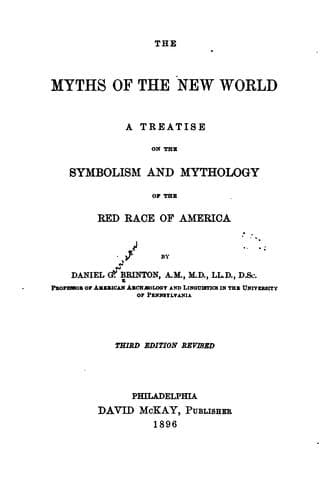
The Myths of the New World: A Treatise on the Symbolism and Mythology of the Red Race of AmericaBrinton, Daniel G. (Daniel Garrison)
Religion
The Myths of the New World: A Treatise on the Symbolism and Mythology of the Red Race of America
Brinton, Daniel G. (Daniel Garrison)
Indian mythology; Indians -- Folklore
Of all such modifying circumstances none has greater importance than the
means of expressing and transmitting intellectual action. The spoken and
the written language of a nation reveal to us its prevailing, and to a
certain degree its unavoidable mode of thought. Here the red race offers
a striking phenomenon. There is no other trait that binds together its
scattered clans, and brands them as members of one great family, so
unmistakably as this of language. From the Frozen Ocean to the Land of
Fire, without a single exception, the native dialects, though varying
infinitely in words, are marked by a peculiarity in construction which
is found nowhere else on the globe,[6-1] and which is so foreign to the
genius of _our_ tongue that it is no easy matter to explain it. It is
called by philologists the _polysynthetic_ construction. What it is will
best appear by comparison. Every grammatical sentence conveys one
leading idea with its modifications and relations. Now a Chinese would
express these latter by unconnected syllables, the precise bearing of
which could only be guessed by their position; a Greek or a German would
use independent words, indicating their relations by terminations
meaningless in themselves; an Englishman gains the same end chiefly by
the use of particles and by position. Very different from all these is
the spirit of a polysynthetic language. It seeks to unite in the most
intimate manner all relations and modifications with the leading idea,
to merge one in the other by altering the forms of the words themselves
and welding them together, to express the whole in one word, and to
banish any conception except as it arises in relation to others. Thus in
many American tongues there is, in fact, no word for father, mother,
brother, but only for my, your, his father, etc. This has advantages and
defects. It offers marvellous facilities for defining the perceptions of
the senses with the utmost accuracy, but regarding everything in the
concrete, it is unfriendly to the nobler labors of the mind, to
abstraction and generalization. In the numberless changes of these
languages, their bewildering flexibility, their variable forms, and
their rapid deterioration, they seem to betray a lack of individuality,
and to resemble the vague and tumultuous history of the tribes who
employ them. They exhibit an almost incredible laxity. It is nothing
uncommon for the two sexes to use different names for the same object,
and for nobles and vulgar, priests and people, the old and the young,
nay, even the married and single, to observe what seem to the European
ear quite different modes of expression. Families and whole villages
suddenly drop words and manufacture others in their places out of mere
caprice or superstition, and a few years' separation suffices to produce
a marked dialectic difference. In their copious forms and facility of
reproduction they remind one of those anomalous animals, in whom, when a
Public-domain text, read in full here on John Shaqi.
Reviews
Reviews
No reviews yet
Be the first to share your thoughts on this work.
Join the Discussion
Join the discussion
Sign in to leave a comment or review.
Sign InorCreate an account