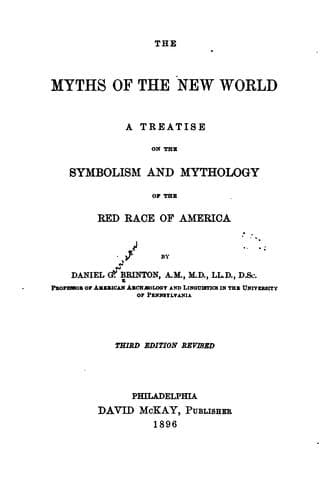
The Myths of the New World: A Treatise on the Symbolism and Mythology of the Red Race of AmericaBrinton, Daniel G. (Daniel Garrison)
Religion
The Myths of the New World: A Treatise on the Symbolism and Mythology of the Red Race of America
Brinton, Daniel G. (Daniel Garrison)
Indian mythology; Indians -- Folklore
Two lights will guide us on this venturesome path. Mindful of the
watchword of inductive science, to proceed from the known to the
unknown, the inquiry will be put whether the aboriginal languages of
America employ the same tropes to express such ideas as deity, spirit,
and soul, as our own and kindred tongues. If the answer prove
affirmative, then not only have we gained a firm foothold whence to
survey the whole edifice of their mythology; but from an unexpected
quarter arises evidence of the unity of our species far weightier than
any mere anatomy can furnish, evidence from the living soul, not from
the dead body. True that the science of American linguistics is still in
its infancy, and that a proper handling of the materials it even now
offers involves a more critical acquaintance with its innumerable
dialects than I possess; but though the gleaning be sparse, it is enough
that I break the ground. Secondly, religious rites are living
commentaries on religious beliefs. At first they are rude
representations of the supposed doings of the gods. The Indian
rain-maker mounts to the roof of his hut, and rattling vigorously a dry
gourd containing pebbles, to represent the thunder, scatters water
through a reed on the ground beneath, as he imagines up above in the
clouds do the spirits of the storm. Every spring in ancient Delphi was
repeated in scenic ceremony the combat of Apollo and the Dragon, the
victory of the lord of bright summer over the demon of chilling winter.
Thus do forms and ceremonies reveal the meaning of mythology, and the
origin of its fables.
Let it not be objected that this proposed method of analysis assumes
that religions begin and develop under the operation of inflexible laws.
The soul is shackled by no fatalism. Formative influences there are,
deep seated, far reaching, escaped by few, but like those which of yore
astrologers imputed to the stars, they potently incline, they do not
coerce. Language, pursuits, habits, geographical position, and those
subtle mental traits which make up the characteristics of races and
nations, all tend to deflect from a given standard the religious life of
the individual and the mass. It is essential to give these due weight,
and a necessary preface therefore to an analysis of the myths of the red
race is an enumeration of its peculiarities, and of its chief families
as they were located when first known to the historian.
Public-domain text, read in full here on John Shaqi.
Reviews
Reviews
No reviews yet
Be the first to share your thoughts on this work.
Join the Discussion
Join the discussion
Sign in to leave a comment or review.
Sign InorCreate an account