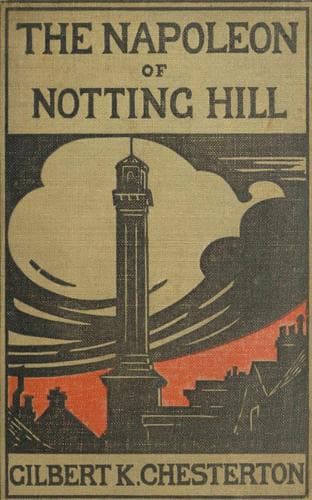
The Napoleon of Notting HillChesterton, G. K. (Gilbert Keith)
Science
The Napoleon of Notting Hill
Chesterton, G. K. (Gilbert Keith)
Fantasy fiction; Notting Hill (London, England) -- Fiction; Political fiction
Then the people went and did what they liked. Let me no longer conceal
the painful truth. The people had cheated the prophets of the
twentieth century. When the curtain goes up on this story, eighty
years after the present date, London is almost exactly like what it is
now.
CHAPTER II--_The Man in Green_
Very few words are needed to explain why London, a hundred years
hence, will be very like it is now, or rather, since I must slip into
a prophetic past, why London, when my story opens, was very like it
was in those enviable days when I was still alive.
The reason can be stated in one sentence. The people had absolutely
lost faith in revolutions. All revolutions are doctrinal--such as the
French one, or the one that introduced Christianity. For it stands to
common sense that you cannot upset all existing things, customs, and
compromises, unless you believe in something outside them, something
positive and divine. Now, England, during this century, lost all
belief in this. It believed in a thing called Evolution. And it said,
"All theoretic changes have ended in blood and ennui. If we change, we
must change slowly and safely, as the animals do. Nature's revolutions
are the only successful ones. There has been no conservative reaction
in favour of tails."
And some things did change. Things that were not much thought of
dropped out of sight. Things that had not often happened did not
happen at all. Thus, for instance, the actual physical force ruling
the country, the soldiers and police, grew smaller and smaller, and at
last vanished almost to a point. The people combined could have swept
the few policemen away in ten minutes: they did not, because they did
not believe it would do them the least good. They had lost faith in
revolutions.
Democracy was dead; for no one minded the governing class governing.
England was now practically a despotism, but not an hereditary one.
Some one in the official class was made King. No one cared how: no one
cared who. He was merely an universal secretary.
In this manner it happened that everything in London was very quiet.
That vague and somewhat depressed reliance upon things happening as
they have always happened, which is with all Londoners a mood, had
become an assumed condition. There was really no reason for any man
doing anything but the thing he had done the day before.
Public-domain text, read in full here on John Shaqi.
Reviews
Reviews
No reviews yet
Be the first to share your thoughts on this work.
Join the Discussion
Join the discussion
Sign in to leave a comment or review.
Sign InorCreate an account