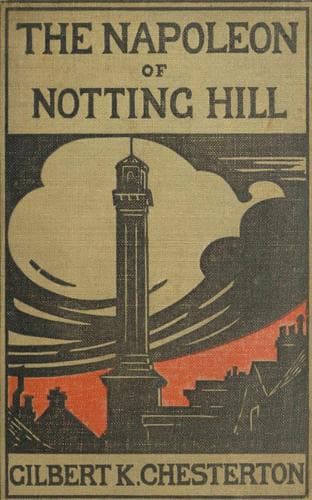
The Napoleon of Notting HillChesterton, G. K. (Gilbert Keith)
Science
The Napoleon of Notting Hill
Chesterton, G. K. (Gilbert Keith)
Fantasy fiction; Notting Hill (London, England) -- Fiction; Political fiction
There was Mr. Benjamin Kidd, who said that the growing note of our
race would be the care for and knowledge of the future. His idea was
developed more powerfully by William Borker, who wrote that passage
which every schoolboy knows by heart, about men in future ages weeping
by the graves of their descendants, and tourists being shown over the
scene of the historic battle which was to take place some centuries
afterwards.
And Mr. Stead, too, was prominent, who thought that England would in
the twentieth century be united to America; and his young lieutenant,
Graham Podge, who included the states of France, Germany, and Russia
in the American Union, the State of Russia being abbreviated to Ra.
There was Mr. Sidney Webb, also, who said that the future would see a
continuously increasing order and neatness in the life of the people,
and his poor friend Fipps, who went mad and ran about the country with
an axe, hacking branches off the trees whenever there were not the
same number on both sides.
All these clever men were prophesying with every variety of ingenuity
what would happen soon, and they all did it in the same way, by taking
something they saw "going strong," as the saying is, and carrying it
as far as ever their imagination could stretch. This, they said, was
the true and simple way of anticipating the future. "Just as," said
Dr. Pellkins, in a fine passage,--"just as when we see a pig in a
litter larger than the other pigs, we know that by an unalterable law
of the Inscrutable it will some day be larger than an elephant,--just
as we know, when we see weeds and dandelions growing more and more
thickly in a garden, that they must, in spite of all our efforts, grow
taller than the chimney-pots and swallow the house from sight, so we
know and reverently acknowledge, that when any power in human politics
has shown for any period of time any considerable activity, it will go
on until it reaches to the sky."
And it did certainly appear that the prophets had put the people
(engaged in the old game of Cheat the Prophet) in a quite
unprecedented difficulty. It seemed really hard to do anything without
fulfilling some of their prophecies.
But there was, nevertheless, in the eyes of labourers in the streets,
of peasants in the fields, of sailors and children, and especially
women, a strange look that kept the wise men in a perfect fever of
doubt. They could not fathom the motionless mirth in their eyes. They
still had something up their sleeve; they were still playing the game
of Cheat the Prophet.
Then the wise men grew like wild things, and swayed hither and
thither, crying, "What can it be? What can it be? What will London be
like a century hence? Is there anything we have not thought of? Houses
upside down--more hygienic, perhaps? Men walking on hands--make feet
flexible, don't you know? Moon ... motor-cars ... no heads...." And so
they swayed and wondered until they died and were buried nicely.
Public-domain text, read in full here on John Shaqi.
Reviews
Reviews
No reviews yet
Be the first to share your thoughts on this work.
Join the Discussion
Join the discussion
Sign in to leave a comment or review.
Sign InorCreate an account