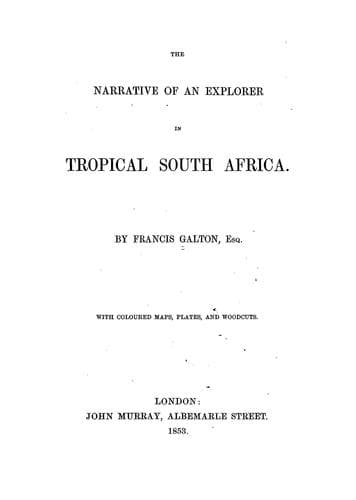
The narrative of an explorer in tropical South AfricaGalton, Francis
History
The narrative of an explorer in tropical South Africa
Galton, Francis
South Africa -- Description and travel
I had spent more hours than an untravelled European would easily give
me credit for, in questioning and cross-questioning Damaras about the
distances we had to go over. Mr. Hahn and Mr. Rath severally, at Barmen
and Otjimbinguè, had helped me to the utmost of their ability, and yet,
on starting, I could not tell whether Omanbondè lay five days off or six
weeks. As a proof of the extreme difficulty of worming out facts from the
Damaras, I may mention that Okandu Fountain, which lay only five miles
from Schmelen’s Hope, and where we slept the first day, was unknown by
the missionaries. At Schmelen’s Hope itself there is only vley (pool)
water and wells, which a dry season might exhaust, and though abounding
in grass, trees, and garden land, the place was reluctantly abandoned,
and the head-quarters of the Mission were established at Barmen, which
has much fewer natural advantages. When Mr. Kolbe, at a subsequent
period, went to Schmelen’s Hope, he merely occupied it as a branch
station. Now, constant inquiries have been made for years as to whether
there were any fountains near Schmelen’s Hope, but without success,
and yet this one, lying in full sight and right in the middle of the
river-bed, had never been spoken of to the Missionaries or discovered by
them. This is not at all an isolated case of the difficulty of getting
the information you want from the savages; they are intensely stupid, and
lie for lying’s sake. One man at Otjimbinguè told me, that if I started
now to Omanbondè, and travelled as fast as I could, it would take me so
long that I should be an old man when I came back.
My plan of journeying was this; to move steadily on, and whenever I came
across water, after three hours’ travel, to stop; in this way my oxen
would keep fresh for any severe exertion they might be called upon to
make, and I should also have more time to learn particulars about the
country, which would be of essential use if I returned in the dry season.
The necks of the oxen had also to become hardened to the yoke; if a raw
was established the beast would be useless.
On the third day’s travel, the long slope, which is the water-shed of the
Swakop, was surmounted, and quite new scenery lay before us. In front
rose the two magnificent cones of Omatako, each appealing as perfect as
that of Teneriffe; to the far left were many broken mountains, some of
which must look down upon Erongo; more northerly lay the long escarpment
of another Ghou Damup mountain, Koniati; and to the westward of north,
a very distant blue hill was seen, which had to be passed on our way to
Omanbondè. The sandy soil was covered with thin dry grass, and a scanty
thorn-coppice, without under-wood, overspread the land.
Public-domain text, read in full here on John Shaqi.
Reviews
Reviews
No reviews yet
Be the first to share your thoughts on this work.
Elsewhere in the archive
Join the Discussion
Join the discussion
Sign in to leave a comment or review.
Sign InorCreate an account