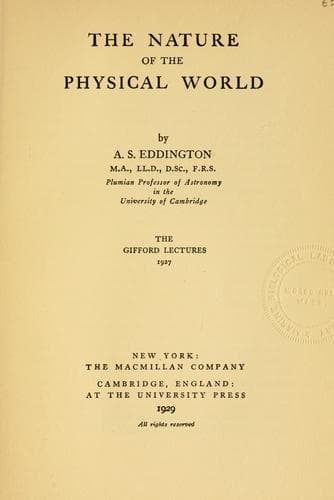
The nature of the physical worldEddington, Arthur Stanley, Sir
Philosophy
The nature of the physical world
Eddington, Arthur Stanley, Sir
Physics -- Philosophy; Science -- Philosophy
But mechanics in becoming geometry remains none the less mechanics. The
partition between mechanics and geometry has broken down and the nature
of each of them has diffused through the whole. The apparent supremacy
of geometry is really due to the fact that it possesses the richer and
more adaptable vocabulary; and since after the amalgamation we do not
need the double vocabulary the terms employed are generally taken from
geometry. But besides the geometrisation of mechanics there has been
a mechanisation of geometry. The proposition about the space-triangle
quoted above was seen to have grossly material implications about the
behaviour of scales which would not be realised by anyone who thinks of
it as if it were a proposition of pure mathematics.
We must rid our minds of the idea that the word space in science has
anything to do with void. As previously explained it has the
other meaning of distance, volume, etc., quantities expressing physical
measurement just as much as force is a quantity expressing physical
measurement. Thus the (rather crude) statement that Einstein’s theory
reduces gravitational force to a property of space ought not to arouse
misgiving. In any case the physicist does not conceive of space as
void. Where it is empty of all else there is still the aether. Those
who for some reason dislike the word aether, scatter mathematical
symbols freely through the vacuum, and I presume that they must
conceive some kind of characteristic background for these symbols. I
do not think any one proposes to build even so relative and elusive a
thing as force out of entire nothingness.
[13]
So far as I can tell (without experimental trial) the man
who jumped over a precipice would soon lose all conception of falling;
he would only notice that the surrounding objects were impelled past
him with ever-increasing speed.
[14]
It will probably be objected that since the phenomena
here discussed are evidently associated with the existence of a massive
body (the earth), and since Newton makes his tugs occur symmetrically
about that body whereas the apple makes its tugs occur unsymmetrically
(vanishing where the apple is, but strong at the antipodes), therefore
Newton’s frame is clearly to be preferred. It would be necessary
to go deeply into the theory to explain fully why we do not regard
this symmetry as of first importance; we can only say here that the
criterion of symmetry proves to be insufficient to pick out a unique
frame and does not draw a sharp dividing line between the frames that
it would admit and those it would have us reject. After all we can
appreciate that certain frames are more symmetrical than others without
insisting on calling the symmetrical ones “right” and unsymmetrical
ones “wrong”.
[15]
One of the tests—a shift of the spectral lines to the
red in the sun and stars as compared with terrestrial sources—is a
test of Einstein’s theory rather than of his law.
Public-domain text, read in full here on John Shaqi.
Reviews
Reviews
No reviews yet
Be the first to share your thoughts on this work.
Elsewhere in the archive
Join the Discussion
Join the discussion
Sign in to leave a comment or review.
Sign InorCreate an account