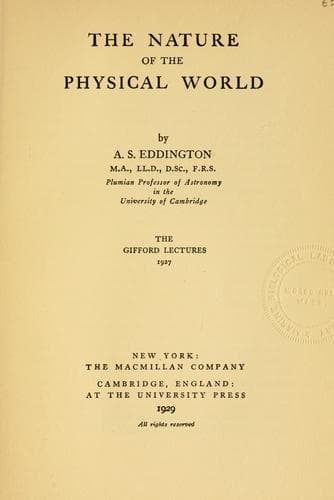
The nature of the physical worldEddington, Arthur Stanley, Sir
Philosophy
The nature of the physical world
Eddington, Arthur Stanley, Sir
Physics -- Philosophy; Science -- Philosophy
[16]
The reader will verify that this is the doctrine the
teacher would have to inculcate if he went as a missionary to the men
in the lift.
[17]
It may be objected that you cannot make a clock follow an
arbitrary curved path without disturbing it by impressed forces (e.g.
molecular hammering). But this difficulty is precisely analogous to the
difficulty of measuring the length of a curve with a rectilinear scale,
and is surmounted in the same way. The usual theory of “rectification
of curves” applies to these time-tracks as well as to space-curves.
[18]
This would be an instantaneous space-triangle. An
enduring triangle is a kind of four-dimensional prism.
[Pg 138]
Chapter VII
GRAVITATION—THE EXPLANATION
The Law of Curvature. Gravitation can be explained. Einstein’s
theory is not primarily an explanation of gravitation. When he tells us
that the gravitational field corresponds to a curvature of space and
time he is giving us a picture. Through a picture we gain the insight
necessary to deduce the various observable consequences. There remains,
however, a further question whether any reason can be given why the
state of things pictured should exist. It is this further inquiry which
is meant when we speak of “explaining” gravitation in any far-reaching
sense.
At first sight the new picture does not leave very much to explain. It
shows us an undulating hummocky world, whereas a gravitationless world
would be plane and uniform. But surely a level lawn stands more in need
of explanation than an undulating field, and a gravitationless world
would be more difficult to account for than a world with gravitation.
We are hardly called upon to account for a phenomenon which could only
be absent if (in the building of the world) express precautions were
taken to exclude it. If the curvature were entirely arbitrary this
would be the end of the explanation; but there is a law of
curvature—Einstein’s law of gravitation—and on this law our further
inquiry must be focussed. Explanation is needed for regularity, not for
diversity; and our curiosity is roused, not by the diverse values of
the ten subsidiary coefficients of curvature which differentiate the
world from a flat world, but by the vanishing everywhere of the ten
principal coefficients.
[Pg 139]
All explanations of gravitation on Newtonian lines have endeavoured to
show why something (which I have disrespectfully called a demon) is
present in the world. An explanation on the lines of Einstein’s
theory must show why something (which we call principal curvature) is
excluded from the world.
In the last chapter the law of
gravitation was stated in the form—the ten principal coefficients of
curvature vanish in empty space. I shall now restate it in a slightly
altered form—
The radius of spherical[19] curvature of every
three-dimensional section of the world, cut in any direction at any
point of empty space, is always the same constant length.
Public-domain text, read in full here on John Shaqi.
Reviews
Reviews
No reviews yet
Be the first to share your thoughts on this work.
Elsewhere in the archive
Join the Discussion
Join the discussion
Sign in to leave a comment or review.
Sign InorCreate an account